Obama Eyeing Internet ID for Americans
Obama Eyeing Internet ID for Americans – Tech Talk – CBS News.
Do we really want the President – or any federal official – establishing our personal Internet ID’s? Â Sounds like government over-reach to me.

Obama Eyeing Internet ID for Americans – Tech Talk – CBS News.
Do we really want the President – or any federal official – establishing our personal Internet ID’s? Â Sounds like government over-reach to me.
I currently publish two blogs: “Discovering Identity†(this one) and “I Love Freedom.†Usually, the information I publish on these blogs doesn’t overlap, but this subject certainly does, and is posted on both sites.
Thanks to an acquaintance, Jane Grafton, I recently read two opposing views on the subject of federal government regulations of privacy:
An LA Times article, Privacy and the Web, concluded:
Although Washington shouldn’t try to micromanage the Net, it should make clear that websites have a duty to help users manage their personal information effectively, giving them the chance to understand the tradeoffs they’re making and to choose wisely.
Phil Lieberman of Lieberman Software responded in his post, “Internet Privacy Is No Place for Government Regulationsâ€:
Attempts by the federal government to constrain the collection of data, and the ability to tailor offers based on this data, is a case of the government meddling in areas where it has no place. Interference with the free market serves only to punish those companies that know how to efficiently mine their data and so is the worst form of government interference with the free market.
I’m all for privacy and opt-in/opt-out options. However I feel it does little good to cripple those companies who are good at business for the purpose of expanding the nanny-state. Any decision to overreach with privacy controls will also provide a bounty for greedy and litigious attorneys looking for fresh kills on the Internet.
What do you think?
Although the LA Times article mildly asks the federal government not to “micromanage the Net,†history has that government has the propensity to always micromanage everything it touches. How’s that for a cynical view?
If I believe the most effective way to deal with this issue would be for private industry to self-regulate. In much the same that PCI DSS has become an effective industry-driven regulation of the credit card industry, perhaps we need an “Online Privacy Standard†developed and enforced by the online industry itself.
Otherwise, if such industry self-regulation doesn’t happen, given the current mood in Congress, I think federal government regulation of online privacy is a foregone conclusion (more cynicism).
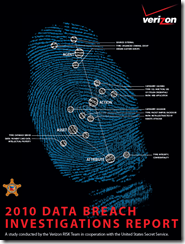
The 2010 Data Breach Investigations Report covers a study conducted by the Verizon Business RISK team in cooperation with the United States Secret Service.
In some ways, data breaches have a lot in common with fingerprints. Each is unique and we learn a great deal by analyzing the various patterns, lines, and contours that comprise each one. The main value of fingerprints, however, lies in their ability to identify a particular individual in particular circumstances. In this sense, studying them in bulk offers little additional benefit. On the other hand, the analysis of breaches in aggregate can be of great benefit; the more we study, the more prepared we are to stop them.
Not surprisingly, the United States Secret Service (USSS) is also interested in studying and stopping data breaches. This was a driving force in their decision to join us in this 2010 Data Breach Investigations Report. They’ve increased the scope of what we’re able to study dramatically by including a few hundred of their own cases to the mix. Also included are two appendices from the USSS. One delves into online criminal communities and the other focuses on prosecuting cybercrime. We’re grateful for their contributions and believe organizations and individuals around the world will benefit from their efforts.
With the addition of Verizon’s 2009 caseload and data contributed from the USSS, the DBIR series now spans six years, 900+ breaches, and over 900 million compromised records. We’ve learned a great deal from this journey and we’re glad to have the opportunity to share these findings with you. As always, our goal is that the data and analysis presented in this report proves helpful to the planning and security efforts of our readers.
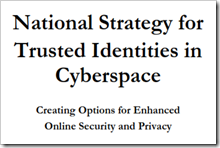
On June 25, 2010, the US Federal Government released a draft document entitled, “National Strategy for Trusted Identities in Cyberspace.†This document proposes a strategy that:
… defines and promotes an Identity Ecosystem that supports trusted online environments. The Identity Ecosystem is an online environment where individuals, organizations, services, and devices can trust each other because authoritative sources establish and authenticate their digital identities.
The Identity Ecosystem enables:
- Security, by making it more difficult for adversaries to compromise online transactions;
- Efficiency based on convenience for individuals who may choose to manage fewer passwords or accounts than they do today, and for the private sector, which stands to benefit from a reduction in paper-based and account management processes;
- Ease-of-use by automating identity solutions whenever possible and basing them on technology that is easy to operate with minimal training;
- Confidence that digital identities are adequately protected, thereby increasing the use of the Internet for various types of online transactions;
- Increased privacy for individuals, who rely on their data being handled responsibly and who are routinely informed about those who are collecting their data and the purposes for which it is being used;
- Greater choice, as identity credentials and devices are offered by providers using interoperable platforms; and Opportunities for innovation, as service providers develop or expand the services offered online, particularly those services that are inherently higher in risk;
The strategy proposes four primary goals and nine actions to implement and promote the Identity Ecosystem:
Goals
- Develop a comprehensive Identity Ecosystem Framework
- Build and implement an interoperable identity infrastructure aligned with the Identity Ecosystem Framework
- Enhance confidence and willingness to participate in the Identity Ecosystem
- Ensure the long-term success of the Identity Ecosystem
Actions
- Designate a Federal Agency to Lead the Public/Private Sector Efforts Associated
with Achieving the Goals of the Strategy- Develop a Shared, Comprehensive Public/Private Sector Implementation Plan
- Accelerate the Expansion of Federal Services, Pilots, and Policies that Align with
the Identity Ecosystem- Work Among the Public/Private Sectors to Implement Enhanced Privacy
Protections- Coordinate the Development and Refinement of Risk Models and Interoperability Standards
- Address the Liability Concerns of Service Providers and Individuals
- Perform Outreach and Awareness Across all Stakeholders
- Continue Collaborating in International Efforts
- Identify Other Means to Drive Adoption of the Identity Ecosystem across the
Nation
The Strategy Document doesn’t discuss any specific technologies, but rather, addresses the needs and general concepts required for a national Identity Ecosystem.
If you would like to make public comments on the strategy, a good place to visit is this IdeaScale page hosted by the Department of Homeland Security. Reading comments from other parties on that page is quite interesting.
In other areas of Cyberspace, the reactions to this strategy are mixed. For example, an active proponent is my friend Dazza Greenwood, who encourages everyone to become familiar with the strategy and actively give feedback:
At the other end of the spectrum is a blogger, Arnold Vintner, whom I do not know, who shares a much more pessimistic view. In his post, “Obama Administration Moves to Reduce Online Privacy,†Mr. Vintner opines:
The Obama administration is proposing a new identity management system for the Internet which is calls “Identity Ecosystem.†This new system will replace individually managed usernames and passwords with a taxpayer-funded federally-managed system.
The scheme is outlined in the National Strategy for Trusted Identities in Cyberspace. The planned system will tie together all of your accounts into one national online identity. This will enable the federal government to easily track all online activity of every American.
The system will start with the federal government requiring the ID’s for use in accessing federal web sites — such as for filing your taxes online. The federal government will then force businesses to adopt the system, starting with banks and credit card companies and slowly spreading to encompass the entire online environment. Once fully implemented, Internet users will no longer be able to comment anonymously on blogs or web forums, because all online identities will be verified with the U.S. government.
Where do you stand? I personally like the idea of public dialog on this issue and the call for public and private entities to participate in a solution. I look forward to giving feedback and tracking progress.
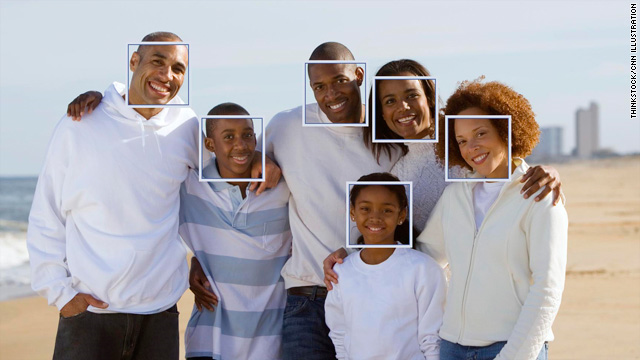
Thanks to Malisa Vincenti, leader of the LinkedIn Group Security & Technology – Critical Infrastructure Network & Forum, for highlighting the CNN article entitled “Why face recognition isn’t scary – yet.â€
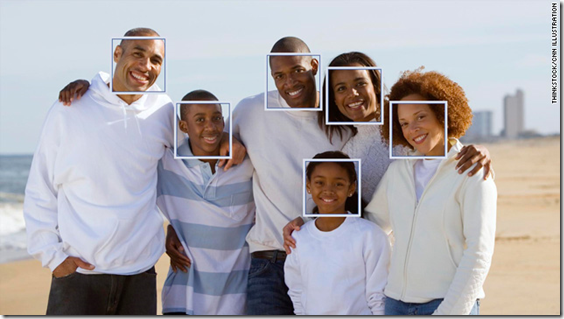
Much of the article was dedicated to describing the benefits and deficiencies of facial recognition software used by online services like Facebook, Picasa and iPhoto to make it easier for users to keep track of photographs. Speaking of such functionality, Michael Sipe, vice president of product development at Pittsburgh Pattern Recognition, a Carnegie Mellon University split-off company that makes face-recognizing software said these types of photo programs are a response to the hassles of keeping track of growing digital photo collections.
"In general, there’s this tsunami of visual information — images and video — and the tools that people have to make sense of all that information haven’t kept pace with the growth of the production of that information," he said. "What we have is a tool to help extract meaning from that information by using the most important part of that media, which is people."
It is interesting that one of the most distinguishing attribute of a person’s identity – his or her face – is so difficult for computers to recognize. We humans often say, “I can remember faces much better than names,†yet computers are just the opposite. It turns out that a person’s smile, which may be one of the most easily-remembered feature of the human face (for us humans, at least), is the most difficult for computers to comprehend:
Anil Jain, a distinguished professor of computer science at Michigan State University, said it’s still not easy, however, for computers to identify faces from photos — mostly because the photos people post to the internet are so diverse.
Computers get confused when a photo is too dark, if it’s taken from a weird angle, if the person is wearing a scarf, beard or glasses or if the person in the photo has aged significantly, he said.
Smiling can even be a problem.
"The face is like a deformable surface," he said. "When you smile, different parts of the face get affected differently. It’s not just like moving some object from one position to another," which would be easier for a computer to read.
So … what will happen when this technology matures and makes the leap from family-friendly Facebook to applications in real live security or survellance applications?
Marc Rotenberg, executive director of the Electronic Privacy Information Center, said the motives behind the technology are what worry him.
Governments and corporations intend to use facial recognition software to track the public and to eliminate privacy, he said, noting that automatically identifying people in public in the U.S., when they are not suspected of a crime, could be a violation of constitutional rights.
When facial recognition comes to surveillance cameras, which are already in place, "you’re no longer racing through iPhoto to figure out how many pictures of Barbara you have," Rotenberg said. "You’re walking around in public and facing cameras that know who you are. And I think that’s a little creepy."
I suppose this is like many other technologies – there are an abundance of positive applications, and the potential for terribly nefarious uses.
For example, if facial recognition can be used to identify terrorists so they could be detained prior to boarding airplanes, we would generally think that was a good application.
Similarly, if I could be granted entrance to my corporate office building or be logged onto necessary computer systems just by smiling (or frowning) into a camera, the building and computer systems might be more secure and the present-day use of passwords or ID cards might go the way of the buggy whip.
However, if an abusive husband used facial recognition software to stalk his estranged wife, or if the government successfully tracked every movement its citizens made in the normal course of events, we would generally think of those applications as negative.
I have a crazy habit of smiling and waving at security cameras I see in airports or banks or convenience stores. Who knows what is happening on the other side? At the present level of today’s technology, I’m probably being recorded and not much more. In a few years, however, the sophisticated software behind the camera will probably recognize Mark Dixon and report my antics to the NSA. That will surely make me frown, not smile, when I wave to the ubiquitous cameras.

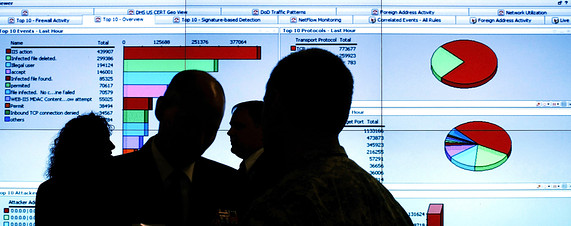
The Wall Street Journal published an excellent article today entitled, “U.S. Program to Detect Cyber Attacks on Infrastructure†(subscription required), reviewing a large U.S. government program, named “Perfect Citizen,†with the stated objective to:
“… detect cyber assaults on private U.S. companies and government agencies running critical infrastructure such as the electricity grid and nuclear power plants, according to people familiar with the program.â€
We all know that the national infrastructure is vulnerable, as I mentioned recently in my blog about NERC Critical Infrastructure Protection (CIP) Cyber Security Standards. The object of this program appears to be an attempt to discover security holes that may not be CIP compliant, and detect patterns of attack before harm can be done.
U.S. intelligence officials have grown increasingly alarmed about what they believe to be Chinese and Russian surveillance of computer systems that control the electric grid and other U.S. infrastructure. Officials are unable to describe the full scope of the problem, however, because they have had limited ability to pull together all the private data.
How do you tackle this challenge? Just monitor the network and find “unusual activity†that may suggest a pending cyber attack.
The surveillance by the National Security Agency, the government’s chief eavesdropping agency, would rely on a set of sensors deployed in computer networks for critical infrastructure that would be triggered by unusual activity suggesting an impending cyber attack, though it wouldn’t persistently monitor the whole system.
This accumulation and analysis of vast amounts of data from numerous sensors is a fascinating topic. Last September, I blogged about work led by Jeff Jonas to analyze large data sets to detect the types of anomalies the NSA are seeking – all to catch threats to the Las Vegas gaming industry. It would be interesting to know if the NSA is building upon his work to find terrorists before they strike.
Of course, any surveillance program led by the NSA is bound to be controversial, and this is no exception:
Some industry and government officials familiar with the program see Perfect Citizen as an intrusion by the NSA into domestic affairs, while others say it is an important program to combat an emerging security threat that only the NSA is equipped to provide.
Who knows … perhaps some day the NSA wizards might think my blogging efforts are a threat to national security and plant sensors to detect my email, blogging and social networking communications activity to see if something fishy is going on. After all, I am not a “Perfect Citizen,†whatever that means. No one is.
"The overall purpose of the [program] is our Government…feel[s] that they need to insure the Public Sector is doing all they can to secure Infrastructure critical to our National Security," said one internal Raytheon email, the text of which was seen by The Wall Street Journal. "Perfect Citizen is Big Brother."
It will be fascinating, in an apprehensive way, to see how this all comes together:
Because the program is still in the early stages, much remains to be worked out, such as which computer control systems will be monitored and how the data will be collected. NSA would likely start with the systems that have the most important security implications if attacked, such as electric, nuclear, and air-traffic-control systems, they said.
I doubt that covert surveillance of US citizens is the initial intent of this program, but unintended consequences are what trouble me. For some diabolical reason, increasing the amount of power vested in any one person or group of people tends to lead to oppression of others. And it sounds like this program will put vast informational power in the hands of a few.
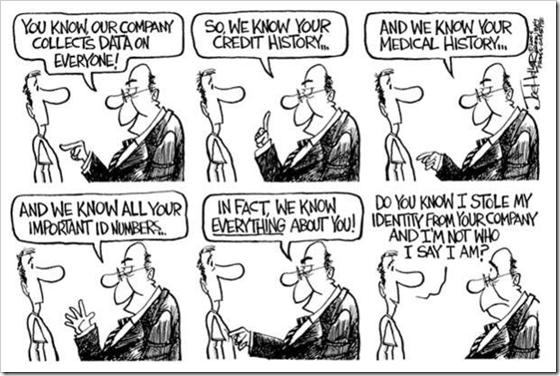
Thanks to @idtexpert for tweeting this humorous commentary on privacy and Identity Theft.
Thanks to Mike Waddingham for sharing the link to an article in the Canadian National Post on Monday:
“Telus announced an electronic health service yesterday that will give patients instant online access to all their medical files.â€
Telus chief executive Darren Entwistle said this move will "revolutionize" health care:
"Now, Canadians will have the ability to create, store and manage their personal health information across their computers and smartphones and, in the future, TVs," Mr. Entwistle said in an announcement at an e-health conference in Vancouver.
"In a world where wireless network technology has enabled powerful mobile computing, their health information can be right at their fingertips, wherever their lifestyles or business travels take them because their smart-phone will accompany them."
The article further states:
In a demonstration, Telus officials showed how a patient could start a personal health record, inputting their own information — from childhood vaccinations, to allergies, to blood pressure readings — to share with their doctors, pharmacists and other health-care providers.
In turn, patients would have access to their medical records, so if they move, see a specialist or end up unexpectedly in an emergency department, vital health information would be instantly available.
Parents would be able to start and maintain health records for their children.
I applaud this type of automation that puts more control of personal health information in the hands of consumers. While it certainly demands necessary privacy and security controls, this move recognizes the need to make health records from multiple sources more available, which should lead to improved health care and reduced costs.
It will be interesting to seek how quickly this type of system become available in the US.
Struggling to understand what the PCI Data Security Standard really means? Please take a few minutes to enjoy a clever short video published by the PCI Security Standards Council. Bob Russo, General Manager of the Council, showed this video as part of his presentation at the Pittsburgh CSO Breakfast Club PCI Security Forum in which I participated last week.
The music might be a bit corny, but the message is right on – and a fun respite from the normal dryness of PCI DSS discussions.
In response to my colleague, Jack Crail, who circulated the link to the video in my previous post, another colleague, Brad Diggs, responded:
Hey Jack,
No this isn’t an urban legend. I have been working up a blog post that gives folks a strategy for how to deal with it. I am the deacon of IT at my church and we have had to deal with it head on. For everyone’s benefit, your best friend in this is Darik’s Boot and Nuke. Of course the best thing is to make sure that the drive is not accessible by anyone that shouldn’t be accessing it. You also need to make sure that you pull the drive when ever you have it serviced, sell it or dispose of it.
Lastly, note that this risk applies to both photocopiers AND printers with internal print queues.
Have a great day!
Brad
Brad followed up that note with an excellent post on his blog recommending a step by step process to deal with the problem.
Thanks, Brad!