[Log In] []

Exploring the science and magic of Identity and Access Management
Friday, December 5, 2025

#IoT, Big Data and Authenticity

Identity, Information Security, Internet of Things
Author: Mark Dixon
Tuesday, May 21, 2013
8:41 pm

Today, I read an interesting white paper, “Big Data in M2M: Tipping Points and Subnets of Things,” published by Machina Research. From the introduction:

This White Paper focuses on three hot topics in the TMT space currently: Big Data and the ‘Internet of Things’, both examined through the prism of machine-to-machine communications. We have grouped these concepts together, since Big Data analytics within M2M really only exists within the context of heterogeneous information sources which can be combined for analysis. And, in many ways, the Internet of Things can be defined in those exact same terms: as a network of heterogeneous devices.

The white paper does a good job of exploring the emerging trends of the Internet of Things, potential business opportunities and challenges faced.

As one could expect, “authenticity and security of different kinds of data,” was identified as a big challenge:

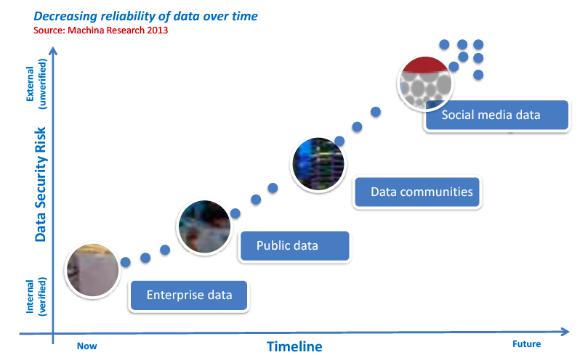
Big Data is about “mashing up” data from multiple sources, and delivering significant insights from the data. It is the combination of data from within the enterprise, from openly available data (for example, data made available by government agencies), from data communities, and from social media. And with every different source of data arises the issues of authenticity and security. Machina Research predicts that as a result of the need for data verification, enterprises will have a greater inclination to process internal and open (government) data prior to mashing-up with social media.

The following diagram shows the increase security risk as more data from external sources is collected and analyzed.

Machina

This yet another indicator of how Identity and Access Management will be critical in the successful evolution of the Internet of Things.

Comments Off on #IoT, Big Data and Authenticity . Permalink . Trackback URL
WordPress Tags:
 

Enabling Collaboration by with Social BPM

Identity
Author: Mark Dixon
Thursday, May 16, 2013
10:15 am

Collaborate

This morning, I was read a recent Oracle White Paper entitled, “Transforming Customer Experience: The Convergence of Social, Mobile and   Business Process Management.”  It gave interesting perspective on the blending of emerging paradigms – mobile and social – with the older discipline of Business Process Management.

To stay ahead in today’s rapidly changing business environment, organizations need agile business processes that allow them to adapt quickly to evolving markets, customer needs, policies, regulations, and business models. … Social and mobile business models have already contributed important new frameworks for collaboration and information sharing in the enterprise. While these technologies are still in a nascent state, BPM and service oriented architecture (SOA) solutions are well established, providing a history of clear and complementary benefits.

The key is effectively leveraging the strengths of existing, proven architectures while taking advantage of new opportunities:

The term “Social BPM” is sometimes used to describe the use of social tools and techniques in business process improvement efforts. Social BPM helps eliminate barriers between decision makers and the people affected by their decisions. These tools facilitate communication that companies can leverage to improve business processes. Social BPM enables collaboration in the context of BPM and adds the richness of modern social communication tools.

… Social BPM increases business value by extracting information from enterprise systems and using it within social networks. Meanwhile, social technologies permit employees to utilize feedback from social networks to improve business processes.

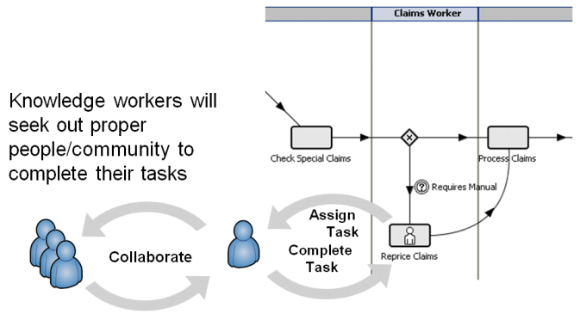
I found one use case presented in the paper to be particularly instructive. As illustrated in the following diagram,

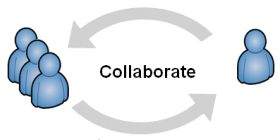
A claims management system assigns a task to an individual claims worker with the expectation that the user will complete the task to advance the process. Of course, to accomplish this type of knowledge-based task, the individual must often engage other people within the business .

Bpm1

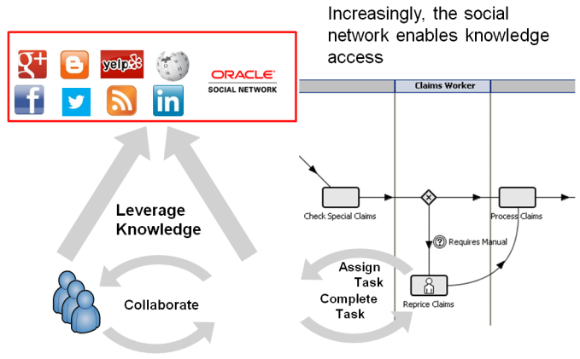
However, Social BPM enables the use of social networking tools to extend collaboration beyond the traditional enterprise boundaries, as shown in the following diagram:

Bpm2

Not only can internal knowledge workers use social networking tools to find each other and share information, but also customers can interact with the process at specific steps, using mobile devices, to supply their own information into a business process. For example, a customer involved in an auto accident might upload photos taken with a cell phone into the process via a claims management app provided by the insurance company.

In order to make this all work, participants will need to use both enterprise and social identity credentials. Because they are using mobile devices, the IAM system must accommodate  mobile, social and cloud infrastructures in order to effectively use information.  This is very much in line with the principles set forth in the Gartner Nexus I addressed yesterday.


Gartner: The Nexus of Forces – Social, Mobile, Cloud and Information

Identity
Author: Mark Dixon
Wednesday, May 15, 2013
3:58 pm

GartnerNexus

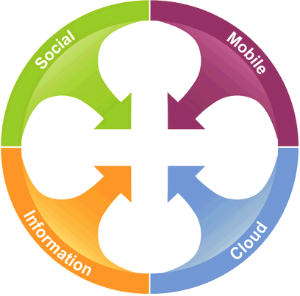
Today I read a year-old document published by Gartner, entitled, “The Nexus of Forces: Social, Mobile, Cloud and Information.”  It explains the interaction among these market forces better than any single document I have read:

Research over the past several years has identified the independent evolution of four powerful forces: social, mobile, cloud and information. As a result of consumerization and the ubiquity of connected smart devices, people’s behavior has caused a convergence of these forces.

In the Nexus of Forces, information is the context for delivering enhanced social and mobile experiences. Mobile devices are a platform for effective social networking and new ways of work. Social links people to their work and each other in new and unexpected ways. Cloud enables delivery of information and functionality to users and systems. The forces of the Nexus are intertwined to create a user-driven ecosystem of modern computing. (my emphasis added)

Excerpts from Gartner’s treatment of each of these areas include:

Social

Social is one of the most compelling examples of how consumerization drives enterprise IT practices. It’s hard to think of an activity that is more personal than sharing comments, links and recommendations with friends. Nonetheless, enterprises were quick to see the potential benefits. Comments and recommendations don’t have to be among friends about last night’s game or which shoes to buy; they can also be among colleagues about progress of a project or which supplier provides good value. Consumer vendors were even quicker to see the influence — for good or ill — of friends sharing recommendations on what to buy.

Mobile

Mobile computing is forcing the biggest change to the way people live since the automobile. And like the automotive revolution, there are many secondary impacts. It changes where people can work. It changes how they spend their day. Mass adoption forces new infrastructure. It spawns new businesses. And it threatens the status quo.

Cloud

Cloud computing represents the glue for all the forces of the Nexus. It is the model for delivery of whatever computing resources are needed and for activities that grow out of such delivery. Without cloud computing, social interactions would have no place to happen at scale, mobile access would fail to be able to connect to a wide variety of data and functions, and information would be still stuck inside internal systems.

Information

Developing a discipline of innovation through information enables organizations to respond to environmental, customer, employee or product changes as they occur. It will enable companies to leap ahead of their competition in operational or business performance.

Gartner’s conclusion offers this challenge:

The combination of pervasive mobility, near-ubiquitous connectivity, industrial compute services, and information access decreases the gap between idea and action. To take advantage of the Nexus of Forces and respond effectively, organizations must face the challenges of modernizing their systems, skills and mind-sets. Organizations that ignore the Nexus of Forces will be displaced by those that can move into the opportunity space more quickly — and the pace is accelerating.

So, what does this mean for Identity and Access Management?  Just a few thoughts:

  1. While “Social Identity” and “Enterprise Identity” are often now considered separately, I expect that there will be a convergence, or at least a close interoperation of, the two areas. The boundaries between work and personal life are being eroded, with work becoming more of an activity and less of a place.  The challenge of enabling and protecting the convergence of social and enterprise identities has huge security and privacy implications. 
  2. We cannot just focus on solving the IAM challenges of premised-based systems.  IAM strategies must accommodate cloud-based and premise-based systems as an integrated whole.  Addressing one without the other ignores the reality of the modern information landscape.
  3. Mobile devices, not desktop systems, comprise the new majority of user information tools. IAM systems must address the fact that a person may have multiple devices and provide uniform means for addressing things like authentication, authorization, entitlement provisioning, etc. for use across a wide variety of devices.
  4. We must improve our abilities to leverage the use of the huge amounts of information generated by mobile/social/cloud platforms, while protecting the privacy of users and the intellectual property rights of enterprises.
  5. Emerging new computing paradigms designed to accommodate these converging forces, such as personal clouds, will require built-in, scalable, secure IAM infrastructure.
  6. The Gartner Nexus doesn’t explicitly address the emergence of the Internet of Things, but IoT fits well within this overall structure.  The scope of IAM must expand to not only address the rapid growth of mobile computing devices, but the bigger virtual explosion of connected devices.

We live in an interesting time. The pace of technological and social change is accelerating. Wrestling with and resolving IAM challenges across this rapidly changing landscape is critical to efforts to not only cope with but leverage new opportunities caused by these transformative forces.

Comments Off on Gartner: The Nexus of Forces – Social, Mobile, Cloud and Information . Permalink . Trackback URL
WordPress Tags: , , , ,
 

Google or Giggle?

Humor, Social Media
Author: Mark Dixon
Tuesday, May 14, 2013
4:30 am

Which type of glasses do you prefer?

Frankandearnest 130514

Comments Off on Google or Giggle? . Permalink . Trackback URL
WordPress Tags:
 

All in a Day’s Work – In Orbit

Space Travel
Author: Mark Dixon
Monday, May 13, 2013
7:32 pm

I love this photo of Chris Cassidy, one of our great NASA astronauts, at work.  

Astronaut


The NASA web site explains:

Repairing the Station in Orbit Expedition 35 Flight Engineers Chris Cassidy (pictured) and Tom Marshburn (out of frame) completed a spacewalk at 2:14 p.m. EDT May 11, 2013 to inspect and replace a pump controller box on the International Space Station’s far port truss (P6) leaking ammonia coolant. The two NASA astronauts began the 5-hour, 30-minute spacewalk at 8:44 a.m.

A leak of ammonia coolant from the area near or at the location of a Pump and Flow Control Subassembly was detected on Thursday, May 9, prompting engineers and flight controllers to begin plans to support the spacewalk. The device contains the mechanical systems that drive the cooling functions for the port truss.

What a thrill it must be for these guys!

Comments Off on All in a Day’s Work – In Orbit . Permalink . Trackback URL
WordPress Tags: ,
 

Business Value in Cloud Computing

Cloud Computing
Author: Mark Dixon
Friday, May 10, 2013
9:40 am

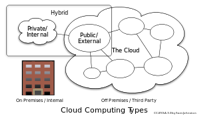
Cloud computing types

In a recent Forbes article entitled, “The Cloud Revolution and Creative Destruction,” Oracle’s Bob Evans put cloud computing in perspective (my emphasis added):

We’ll begin to see the real the real creative-destruction power of the cloud unleashed when we begin to define the cloud in terms of what business customers want and need, and when we stop diddling around with inside-baseball constructs that mean little or nothing to the businesspeople who are ready to spend many tens of billions of dollars on cloud solutions that focus on and deliver business value. .. 

That’s the real magic of the cloud: it lets businesses rethink where and how they deploy their precious IT dollars, and allows those businesses to focus more of their IT budgets on projects that truly matter.

Business value.  Focusing here makes cloud computing worthwhile.

Comments Off on Business Value in Cloud Computing . Permalink . Trackback URL
 

Humanoid Robot in Space

Identity, Space Travel
Author: Mark Dixon
Friday, May 10, 2013
9:22 am

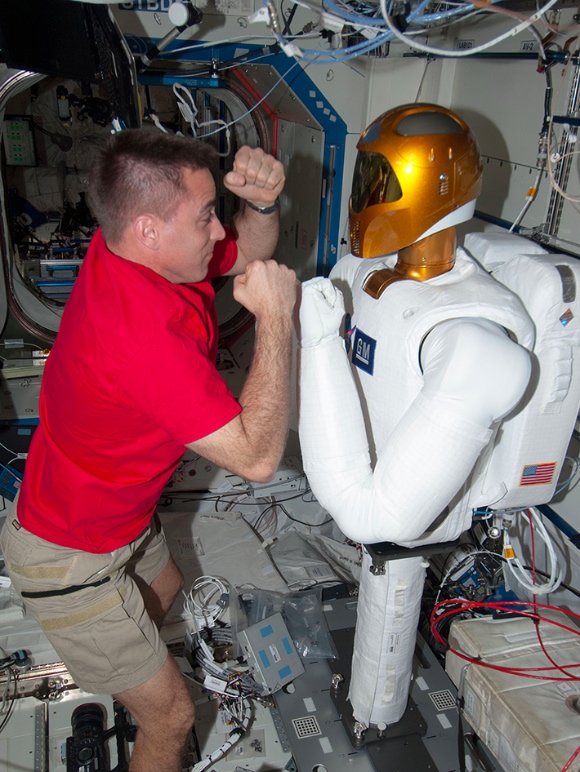
In the NASA photo below, Expedition 35 Flight Engineer Chris Cassidy has a few light moments with the Robonaut 2 in the Destiny Laboratory onboard the Earth-orbiting International Space Station.

Robonaut 2, or R2, is a dexterous humanoid robot built and designed at NASA Johnson Space Center in Houston, Texas. Sent to the International Space Station in 2011 with the intention of aiding astronauts on dangerous tasks and freeing them from some the more mundane work, upgrades to the R2 system continue to produce novel advances in the field of robotics. 

IronMan he isn’t, but it’s fun to see advances in robotic technology. And even robots have identity.

NASArobot

Comments Off on Humanoid Robot in Space . Permalink . Trackback URL
WordPress Tags: ,
 

Connected Personal Clouds – Relationships Matter

Identity, Personal Cloud
Author: Mark Dixon
Thursday, May 9, 2013
9:49 pm


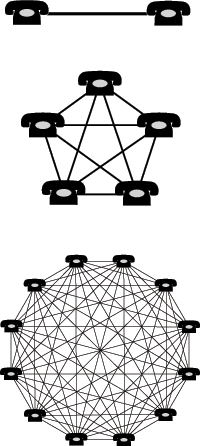
Network effect

To me, one of the most compelling parts in Phil Windley’s recent white paper, “Introducing Forever: Personal Cloud Application Architectures,” was the emphasis placed on relationships between personal clouds.  A few statements that intrigued me (emphasis added):

One of the most important features of the Kynetx CloudOS is its built-in support for personal channels. …

Even more so than personal computers, personal clouds are only interesting when they are connected. The connection between two personal clouds—or between a personal cloud and anything else it is connected to is called a personal channel. The network of people and organizations linked via personal channels is called a relationship network. …

Personal channels on an open-standard relationship web can be dramatically more useful to individuals and businesses than ordinary email or Web connections. Forever makes use of personal channels by using them as the conduits over which permissioned access to profile information for the user’s contacts occurs.

I expect that relationships between personal clouds, not the personal clouds themselves, will provide the fuel to ignite and accelerate substantive growth in the use of personal clouds. The “network effect” emerging as an expanding social graph is instantiated in a personal cloud architecture could create a bandwagon of growing adoption.

The question remains … what “killer application” or set of applications built on a personal cloud architecture will trigger such a crescendo?

Comments Off on Connected Personal Clouds – Relationships Matter . Permalink . Trackback URL
 

Digital Arizona Broadband Test

General, Technology
Author: Mark Dixon
Wednesday, May 8, 2013
9:16 am

DigitalArizona

This morning, I responded to an invitation from the Arizona Telecommunications and Information Council to participate in “The Official State of Arizona Internet Speed Test.”

The Digital Arizona Program:

… created an Internet Speed Test and Survey on the Digital Arizona web portal to measure the upload and download (connection) speeds at tens of thousands of locations (i.e. homes, offices, etc.) around the State. The combination of data from large quantities of speed tests along with answers from the related survey questions will be analyzed by the Digital Arizona team to determine potential areas and/or communities that may be poorly served. … This will assist us with our goal of facilitating access to better high-speed Internet service for ALL Arizonans, especially those residing in the rural areas of the State.

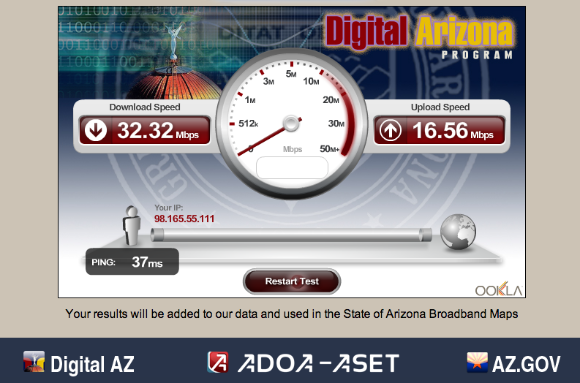
Here are my results:

DigitalArizona2


Not bad service!  But, of course, I live in the city of Mesa, AZ, not in a rural area.  We’ll see what service we get during our family reunion in Pinetop-Lakeside, AZ, later in the summer.

Comments Off on Digital Arizona Broadband Test . Permalink . Trackback URL
 

“Visicalc” of Personal Clouds?

Identity, Personal Cloud
Author: Mark Dixon
Wednesday, May 8, 2013
7:47 am

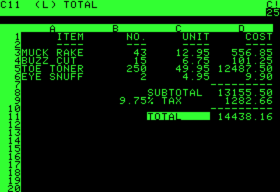
Visicalc

This morning I read a tweet from Marc Davis that quoted a profound statement from Johannes Ernst:

@Johannes_Ernst: “We do not know yet what will be the ‘VisiCalc’ of Personal Clouds” #IIW #pcloud #personaldata.

I think Johannes hit the nail squarely on its head.  The concept of Personal Clouds is very intriguing, but still in the hobbyist stage.

If I recall correctly, the first time I saw Visicalc demonstrated was on a TRS- 80 machine.  It was crude by today’s standards, but revolutionary in what we could do with it.

Wikipedia quotes Thomas Hormby, who stated: 

VisiCalc … is often considered the application that turned the microcomputer from a hobby for computer enthusiasts into a serious business tool.

What will be the application that turns Personal Clouds into a serious tool and triggers rapid growth? I would hope that universally accepted, personally managed Identity credentials and mobile payments will be early winners, but who knows?

Comments Off on “Visicalc” of Personal Clouds? . Permalink . Trackback URL
WordPress Tags: ,
 
Copyright © 2005-2016, Mark G. Dixon. All Rights Reserved.
Powered by WordPress.