[Log In] []

Exploring the science and magic of Identity and Access Management
Sunday, November 29, 2026

Paypal: Combating Cybercrime


Identity, Information Security
Author: Mark Dixon
Thursday, May 19, 2011
1:20 pm

Michael Barrett, Andy Steingruebl, Bill Smith of Paypal have collaborated on an excellent white paper entitled, “Combating Cybercrime – Principles, Policies, and Program.”  I highly recommend it to you.

Rather than attempt an analysis at this time, please let me share a segment of an introductory paragraph …

What is possible, and perhaps even likely should current trends continue, is the perception by Internet users that the Internet is unsafe and therefore unsuitable for everyday use. Should this perception become widespread, crowd psychology could take hold and as with the recent world financial crisis, result in a loss of faith in “the system”. Certainly there were very tangible and real issues behind the financial crisis, but the long-lasting impact has proven to be the perceptual shift resulting in the Great Recession.

… and a portion of their conclusion:

The authors believe that cybercrime, and other cyber issues are the one area that could cause this type of loss of faith in the safety of the Internet In this white paper, the authors lay out an entire framework of practical actions that could be taken to reduce the impact of cybercrime, and substantially make the Internet safer. Even if only some of these recommendations are implemented, it will make a significant improvement in Internet safety. While we’re hesitant to name any of these initiatives as being more important than any other, we are occasionally asked “list the three things you want us to do”. In general, we list:

  • Increase investment in cybercrime law enforcement.
  • Start the Internet NTSB.
  • Fix the Cybercrime Convention.

Just doing those three things would make a big difference, albeit it would be – to paraphrase the punchline of many a joke – merely “a good start”. We expect this paper to be a first step in a multi-stakeholder and iterative process and approach to making substantial progress against cybercrime. We welcome feedback on our proposals.

In between these bookends lies a thought-provoking analysis of the basic problems, the challenges and roadblocks that complicate potential solutions, and a decisive call to action to bring about a coordinated ecosystem change.  The authors propose ten underlying principles and a series of specific recommendations, ranging from international law enforcement to forcing unsafe devices off the Internet.

I believe this document will help foster and accelerate interactions among the appropriate business, government and user communities to make signifiant progress.  We all have a stake in this.  This document will help us understand the issues and get involved.

Comments Off on Paypal: Combating Cybercrime . Permalink . Trackback URL
WordPress Tags: ,
 

Word of the Day: “Frenemies”

Cloud Computing
Author: Mark Dixon
Saturday, May 14, 2011
9:45 pm

The new word I added to my vocabulary today is “Frenemies,” proposed in an interesting TechCrunch article, “Competing In The Cloud—Let’s Be Frenemies,” authored by Prasad Thammineni, CEO and Co-Founder of OfficeDrop, a scanner software and digital filing system. Prasad sets the stage by saying:

Competition between software companies used to mean safeguarding your code and suing anyone that came close to it. Today, many larger technology companies are adopting a different strategy of actually bringing new users to companies they would have tried to squash a decade ago. The cloud is changing the old-school software mentality that a customer’s data needs to be locked down—giving rise to a new ecosystem where everything interoperates. So companies that in the past would have been bitter enemies are now working together as pseudo-friends—“frenemies, ” if you will.
…

Proprietary, closed systems are being replaced with interconnected services that let the user’s data flow. Earlier this year, the Washington Post pointed to a new era of collaboration amongst software giants like Google and Microsoft, and cited the revolving door of talent in the Valley as a key driver in this cooperation.

So, how do we compete in this new world? Prasad recommends three things:

  1. do something better than anyone else
  2. make it easy for others to add on services to your own and
  3. make it work with the platforms that your ideal customers are already using—even if what they’re using seems quasi-competitive to your own product

Good advice, I think, for all of us who are connected in cyberspace. I think I’d rather be friends with you than enemies, but I do like this new word, “Frenemies.”   It seems much more on-line and in the clouds than the old-school “coopetition” that has bounced around the business vernacular for years.

Comments Off on Word of the Day: “Frenemies” . Permalink . Trackback URL
WordPress Tags: ,
 

Craig Burton on the Live Web and Internet of Things

Identity, Technology
Author: Mark Dixon
Saturday, May 14, 2011
8:46 am

Craig BurtonCraig Burton, who recently joined Kuppinger Cole, authored an insightful article, “Bringing the Web to Life at Last,” addressing two compelling topics: “The Live Web” and the “Internet of Things“.  His final statement provides an apt summary:

We don’t need a Facebook of Things. We need an Internet of Things. We need the Live Web.

Craig outlines the basis concepts of the Live Web:

The term Live Web was first coined by Doc Searls and his son Allen Searls to describe a Web where timeliness and context matter as much as relevance. It blossoms with the following three assumptions:

  • All things are connected to the Internet.
  • All things are recorded and tagged.
  • All things can be recalled and accessed in context.

The Live Web is made up of three core principles that give rise to generating context:

  • First principle: Ubiquitous programmable data access. (APIs)
  • Second principle: Ubiquitous event-based endpoints.
  • Third principle: Ubiquitous event-based evaluation and execution machines.

Note that the three principles match the three assumptions.

Craig explains how, even if all devices are connected to the Internet (the Internet of Things), the current web paradigm, as wonderful as it is, would not work well, because the current web operates as a tightly-coupled manner, like Facebook:

The problem with the idea of a big “Facebook of Things” kind of site is the tight coupling that it implies a person would have to take charge of all the devices. You would have to “friend” each one. And remember, these are devices, so not only do you have to connect and “friend” them but you will be doing the work of managing them.

…

This just isn’t going to happen. Ever.

However, applying Live Web principles and loosely coupling the device will enable the Internet of Things to work:

Each device can interpret that message however it sees fit or ignore it altogether. This significantly reduces the complexity of the overall system because individual devices are loosely coupled.

It will be fun to see the progressive realization of these concepts: all devices connected to the Internet and coupled in a loose sort of way that makes possible all kinds of interesting applications.  I just  wonder how long will it be before I can sit here at my desk and command my Live Web connected kitchen to cook me up a nice omelette for breakfast?


Stars and Stripes Honor Flight – Honoring WWII Veterans

Family
Author: Mark Dixon
Saturday, May 14, 2011
4:29 am

Please join me in saluting the veterans of World War II. My dad and dad-in-law are but two member of this extraordinary group of brave individuals. They both celebrate their 87th birthdays this year. I take my hat off to them and all those who served with them in defense of our freedom.

Comments Off on Stars and Stripes Honor Flight – Honoring WWII Veterans . Permalink . Trackback URL
WordPress Tags: , ,
 

Comic Relief … and Therapy

Humor
Author: Mark Dixon
Thursday, May 12, 2011
5:07 pm

One the few things that keeps me attached to a daily newspaper is the comic strip page.  Often, the rye wisdom of the comics seems more logical than the real world and more therapeutic than a shrink.  And some days are more fruitful that others … when the odd combination of my state of mind and ink on the page seem to resonate in a special way.  Today was one of those days.

From Zits, Drabble and Pickles: Youthful exuberance and postive thinking run smack dab into the challenges of skepticism, shape and age.

The big question … Where do I (and you) fit in? 🙂


Comments Off on Comic Relief … and Therapy . Permalink . Trackback URL
WordPress Tags: , , ,
 

Nostalgia for Nate Thurmond

Sports
Author: Mark Dixon
Tuesday, May 10, 2011
8:01 am

Yesterday, for some unknown reason, I received an email with an alluring offer: “Courtside Seats became available right next to the Warrior’s bench.  Not only do they provide a great view, but you can hear the interaction between players and you are really part of the game!”

I’m not sure how a guy in Arizona could really take advantage of season tickets to Golden State Warriors basketball, but the offer triggered pleasant memories of my first introduction to professional basketball, featuring an earlier version of the Warriors team.  

As a young boy growing up in southern Idaho, we didn’t have television in our home, but at night, our old tube AM radio could tune into faraway stations like KNX in Los Angeles, KSL in Salt Lake City and KNBR in San Francisco. KNBR was home to the San Francisco Warriors, who played in the Cow Palace and featured emerging star Nate Thurmond.  How I loved to listen to the games and imagine the fantastic plays of those talented athletes.


I don’t remember many details about those old games, but seeds sown back then grew into my great love for the game of basketball.  As I watched the Oklahoma City / Memphis 3OT thriller last night, it was great to think back across the years and realize again how much I love the game.

Comments Off on Nostalgia for Nate Thurmond . Permalink . Trackback URL
WordPress Tags: , , ,
 

IAM Lifecycle Management for (Take Your Pick)

Identity
Author: Mark Dixon
Friday, May 6, 2011
3:58 pm

We in the IAM world do a fairly good job of addressing “User Lifecycle Management” and “Role Lifecycle Management” issues, but are generally abysmal in other areas that beg to be governed by full-functioned, easy to use, lifecycle management principles.

What are lifecycle management principles?  I propose that the following apply:

  1. Application of standard, repeatable, and easy-to-use methods for creating, configuring, changing, approving, invoking and terminating objects.
  2. Ability to execute these methods directly or through delegated administration functionality.
  3. Ability to verify correct operation through process transparency and consistent audits.
  4. Ability to easily manage objects individually or in large sets.

In order to benefit from lifecycle management principles, objects need to have characteristics such as these:

  1. a beginning
  2. an end
  3. dynamic configuration over time
  4. need of approvals for creation, changes and termination
  5. operative dates/times for each step in the lifecycle
  6. object versioning

Given these two lists, what types of objects in an Identity and Access Management system beg for Lifecycle Management?  At least these:

  1. Users
  2. Roles
  3. Entitlements
  4. Policies (for provisioning, access control, authorization and audits)
  5. Managed Systems (applications, systems, devices, etc.)
  6. Workflows/Processes
  7. Forms
  8. Configurations

Wouldn’t it be great if there was a single coordinated, cohesive user interface for providing lifecycle management of all these objects? Certainly, there are significant differences between object types, but the processes of keeping them all under control over time have more similarities than differences.

We still think too much in silos, rather than in integrated architectures.  If we are to ever reach the worthy objectives of ease of use, rapid implementation and effective administration, we must successfully conquer this lifecycle management problem.


Comments Off on IAM Lifecycle Management for (Take Your Pick) . Permalink . Trackback URL
 

Business Continuity as a Service?

Business
Author: Mark Dixon
Thursday, May 5, 2011
12:45 pm

My cyberspace friend André Koot recently translated his provocative blog post, entitled “Continuity as a Service,” from Dutch to English.  If you are interested in cloud computing, I highly recommend that you take time to read the article.

I like André’s comment about cloud computing in general:

The cloud reminds me of that old Blob, the science fiction movie, cloud is becoming so pervasive that it seems to take control of everything. And just admit it, we find that exciting, scary and fun at the same time. But if everything disappears in the fog, how do we know that business is as usual?

We all know that cloud computing has new risks and challenges.  But one risk that is often overlooked is business continuity:

Most risks are well known. Using standard operating procedures, access control and audits we can identify and mitigate problems relatively easy. And already there is a lot of information about security in the cloud. But one area of risk is not yet completely clear, the risks of business continuity.

Although new legal relationships are essential, they certainly don’t solve everything.

But the core of the AAS problem is that contract partners are not always the parties who offers the actual service. You can try to mitigate risks in contracts, but the fact of the matter is that you want to move to the cloud, because of the positive price / performance ratio of multi-tenancy and the (re) use of standard applications. Long term subcontractor relations in the real world don’t exits in the Cloud. If one platform provider is too expensive, our service provider just moves to another. This means that we are victims of the arbitrariness of our providers.

André  goes on to explore several situations that should be carefully considered:

  • What happens if the SAAS provider goes away?
  • Is “Cloud Escrow as a Service” a valid concept?
  • What happens if the PAAS provider underneath the SAAS provider goes away?
  • What measures should you take now so you can endure a cloud failure?

André’s parting comments are certain timely:

The uncertainty surrounding continuity is high at this moment. The question is whether for business-critical applications sensible solutions in the cloud exist today. An assessment around the continuity and security risks and safeguards in place seems to be appropriate.

Amazon’s recent challenges certainly focused our collective attention on this important subject. In order for the challenges related to business continuity in cloud computing to be solved, there is much work to be done.

By the way, I thought the photo of a life preserver in the clouds was very appropriate for this post. It came from a blog post about business continuity by Maurice Saluan, VP-Channel Management for Zenith Infotech, a company heavily involved in cloud computing and business continuity.

Comments Off on Business Continuity as a Service? . Permalink . Trackback URL
WordPress Tags:
 

Time is Relative

General
Author: Mark Dixon
Thursday, May 5, 2011
11:52 am

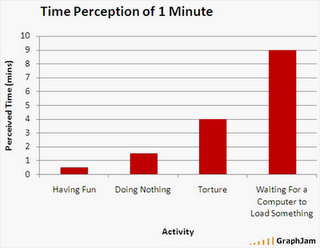
It has been reported that Albert Einstein explained his theory of relativity this way:

If you spend two hours speaking with a beautiful woman, you feel, at the end of the two hours that you’ve spent only two minutes with her; while if you spend two minutes sitting on hot tin, you feel you’ve spent two days!

I recently stumbled across a graph that seemed to convey the same message:

Perhaps these examples will work for those who have never spent time with a beautiful woman.


Comments Off on Time is Relative . Permalink . Trackback URL
WordPress Tags: ,
 

A “New” Commodore 64?

Technology
Author: Mark Dixon
Thursday, May 5, 2011
11:10 am

How many of  you old geeks remember the Commodore 64, an 8 bit home computer released in January 1982? It has a whopping 64kb (that is K, not G) of RAM and cost only $595.

According to PC World, you will soon be able to get a brand new model, appropriately updated for our times:

It’s got a Dual Core 525 Atom processor, an Nvidia Ion2 graphics chipset, 2GB of RAM (upgradeable to 4GB), a 160GB hard drive, and built-in Wi-Fi. On the left side of the keyboard there’s a slot or tray-load DVD (upgradeable to Blu-ray), and on the right side there’s a multi-format card reader, along with a USB 2.0 port. The rear features four additional USB 2.0 ports; mouse and keyboard PS/2 ports; DVI, VGA, and HDMI ports; Ethernet; and support for 6-channel HD audio. It runs Linux, but you can install Windows if you like.

So, if you yearn for the nostalgic, but crave the modern, this just might be for you!

Comments Off on A “New” Commodore 64? . Permalink . Trackback URL
WordPress Tags: ,
 
Copyright © 2005-2016, Mark G. Dixon. All Rights Reserved.
Powered by WordPress.