The Standard Tax Refund

In honor of USA tax day … a bit of Wizard of ID levity.  I would laugh harder if it weren’t so close to the truth.
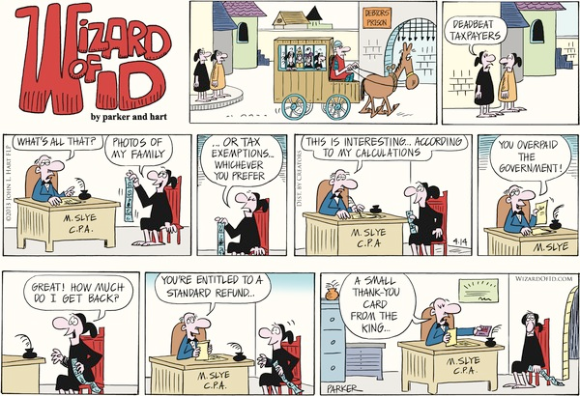

In honor of USA tax day … a bit of Wizard of ID levity.  I would laugh harder if it weren’t so close to the truth.
This morning I watched an interesting webcast where Bob Evans, Oracle’s Senior Vice President, Communications spoke with Jean-Marc Frangos Managing Director, External Innovation, BT Technology Service and Operations, on the subject of innovation to provide outstanding customer experience.  I was impressed with a statement Frangos made:
“Innovation is not something a special team does—it is something that must be ingrained in the mindsets and behaviors of everyone, and for which, ideally, there should be no special process.”
I learned that last year, Oracle sponsored a study on this subject by the Economist Intelligence Unit, “Cultivating Business-Led Innovation:”
The study, including results from a survey of 226 global respondents, also features customer, author, and expert interviews on strategies for fostering innovation, along with information about technologies that support innovation and lead to competitive advantage.
The study concluded six recommendations for improving the process of business-driven innovation:
Culture comes from the top: it’s up to the leadership to set a tone that makes workers feel empowered to innovate—and allowed to fail.
Success in innovation is also about failure: redeploying members of teams involved in failed innovations can help to increase the prospect of success elsewhere by ensuring that learnings are disseminated.
Pushing down authority is an enabler: empowering smaller teams to build their own tools to solve business problems helps to give rise to wider innovations.
Encourage small iterative projects: These set up an environment in which repeated experimentation and learning reï¬ne winning ideas.
Disruptive technology trends are empowering: executive respondents to our survey feel that the IT department should play a key role in educating business leaders about new technology trends. Knowledge is of course critical to using new technologies appropriately and effectively.
Get everyone involved: look for opportunities to increase the cross-fertilisation of ideas between as many business units as possible. Encourage customer participation and customer data comparisons in innovation initiatives.
Innovation is tough, especially for big companies with competing priorities. Â It is always enjoyable to be involved with intelligent, motivated people who believe in innovation and create outstanding results.
Last Thursday, I participated in the Privacy Tweet Chat led by @OracleIDM, featuring Dr. Ann Cavoukian, Information and Privacy Commissioner of Ontario Canada, tweeting as @embedprivacy.  The #PrivQA chat archive is available now on Storify.

I always enjoy these tweet chats, and invariably learn more than I contribute. Â Perhaps the key insight I gained in this chat is summarized in this tweet that I posted later in the chat:
Privacy is freedom to decide how my data is used. Security is the mechanism to enable and protect that freedom of choice. #PrivQA
Â

Now I know why I don’t make progress some times. Â There is an infinite loop in my design.
Courtesy xkcd.
The most intriguing thing to hit my desk today was the announcement of the new Mammoth service to “save links, add notes, and selectively grab content from multiple webpages into a single, shareable, organizable document.”Â
I followed a tweet from @paulmadsen and reserved my name.  You can reserve your name, too, by clicking here, or on the image below.  If you click here and reserve your name, you will be in line to use the service, and I will be one step closer to getting my account activated (I need a couple more friends to click through). We will both be one step closer to testing how to collaborate on Mammoth.  Thanks for clicking!
I do think these guys understand privacy. Â See below the image for more …

I like the sound of what they say about security and privacy:
security and privacy are top of our list …
We want to make sure nothing gets leaked unless you specifically expose it to the world. So no, no social networks to login, no weird permissions to manage, no scary dreams of that weird things you like making it out into the world. Its just simple. …
Our entire business is based on your trust – why would we screw with that? To put simply, we don’t have any reason to misuse any information we collect. And we only capture data thats needed to enable a feature for you, nothing else.
Could this be a “personal cloud” that I can really use?  It has my name on it.  It sounds like it will be secure. I look forward to checking it out. Â

On today’s @OracleIDM / @embedprivacy #PrivQA Tweet Chat, much was said about the right of individuals to control how their data was being used. I posted the following statement:
Privacy is freedom to decide how my data is used. Security is the mechanism to enable and protect that freedom of choice. #PrivQA
While our primary focus on the Tweet Chat was on the collection and care of data, I learned today that there is another major movement, primarily in Europe, about a proposed “right to be forgotten.”
According to an article in The Guardian, Viktor Mayer-Schönberger, professor of internet governance at the Oxford Internet Institute, describes himself as the “midwife” of the idea of the right to be forgotten. He advocates:
an “expiration date” (a little like a supermarket use-by date) for all data so that it can be deleted once it has been used for its primary purpose
Mayer-Schönberger cites research that shows:Â
90% of the 60+ generation want this … 84% of 18- to 24-year-olds – those born into the digital age … want the right to be forgotten to be legislated
Furthermore, he claims:
it’s not just about the legal, moral and technical arguments – but about what it is to be human.
That’s pretty heavy, but worth thinking about.
On a lighter note, I received a tweet today that clearly shows something that Dwight Howard of the Los Angeles Lakers would prefer we all forget:
Dwight Howard has missed more FTs this season (332) than Steve Nash in his entire 17-year career (322)
Wow! That is worth remembering – or forgetting – depending on your point of view.
Â

XRIÂ -Â An extensible resource identifier (abbreviated XRI) – a scheme and resolution protocol for abstract identifiers compatible with uniform resource identifiers and internationalized resource identifiers, developed by the XRI Technical Committee at OASIS.Â
i-name – a human readable XRI intended to be as easy as possible for people to remember and use.
I recently received an email from Drummond Reed with his usual =drummond signature at the bottom.  It made me remember that I had once registered my own ii-name, “=mgd”.  I had never really used it, but still see it as an intriguing concept – my own, persistent identifier that aligns nicely with my Twitter handle, @mgd.  (I still regret that I didn’t register the mgd.com domain when I had a chance.)
So, now =mgd is alive and active, registered at 1id.com.  You can request contact with me by clicking on the =mgd link here or on the =mgd icon in this post or on the sidebar.
I’m still not certain how I’ll use =mgd beyond this, but Drummond told me some interesting things are on the near horizon.
By the way – clicking on my other i-name, =markdixon, will take you to my about.me page.  I’m slowly trying to weave my social media presence together.
Empathy:Â The capacity to recognize emotions that are being experienced by another sentient or fictional being.
Will we ever be led by robots  – with or without empathy?
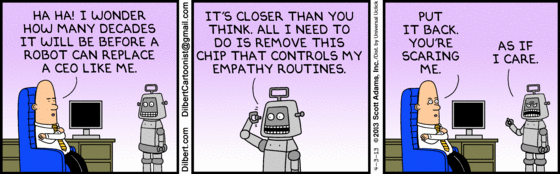
I doubt that anyone has ever accused Larry Ellison of being a robot.
Jay Deragon’s post today was entitled, “Reframing the Meaning of Work.” Â The final phrase in the post was “learn to be simple.”
The proposed simplicity?
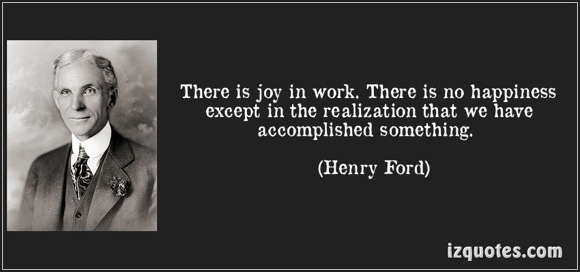
work with a purpose creates joy …
work that creates joy creates happy customers …
happy customers are loyal and more profitable.
How does this affect employees?
What happens when someone wants to pay you to do what you love to do? The meaning of work then changes to an extension of your natural talents and instead of labor there is joy.Â
How about entrepreneurs?
The reason entrepreneurs love to work and usually don’t consider how much time they spend working is because they intrinsically understand the purpose of their work and it satisfies their heart and mind.
How does this affect you? Â What is your purpose in work? Does it bring you joy?