Left or Right Brained? Take the test.

I took the short Sommer + Sommer brain test and found that I use both sides of my brain almost equally.  That was a bit surprising to me.  I expected that I’d be more predominantly logical. 🙂
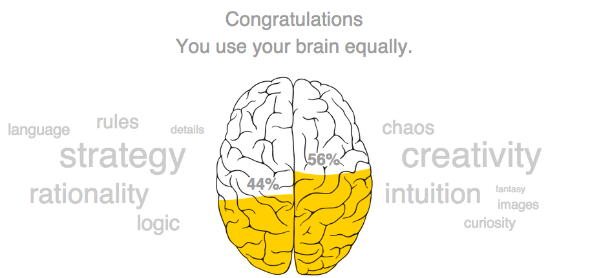

I took the short Sommer + Sommer brain test and found that I use both sides of my brain almost equally.  That was a bit surprising to me.  I expected that I’d be more predominantly logical. 🙂
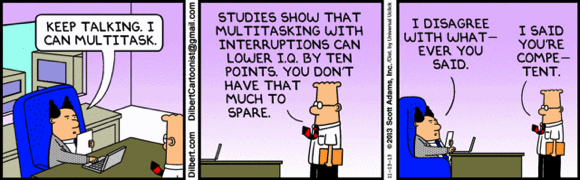
Does multi-tasking just spread what limited IQ I have around to the different projects I do? Â Sometimes I feel like that.
The following video features Ann Cavoukian, Ph.D., Information and Privacy Commissioner, Ontario, Canada, discussing the paper I co-authored with her, “Privacy and Security by Design: An Enterprise Architecture Approach.”
Recently, my colleague Eric Stephens pointed out an interesting online data visualization service, called Raw. I just had to try it out.
The following circle chart shows the top ten nations from which people have reached my Yellow Jeep Project Facebook page – ranging from 3,007 for the USA down to 5 from Mexico. Fun tool to use; interesting visualization of some simple data.


My recent post about the book, “Age of Context: Mobile, Sensors, Data and the Future of Privacy,†by Robert Scoble and Shel Israel, began to explore the benefits that might accrue from converging technologies of the “perfect storm” of mobile devices, social media, big data, sensors and location-based services. But what effect will this have on personal privacy?
Scoble and Israel provide these comments in the final chapter of the book, entitled “Trust is the New Currency”:
We have spoken to hundreds of people and looked at hundreds of technologies, and we firmly believe that adding context will make the world an easier, more efficient, cleaner and more productive place.
However, we’d be negligent if we didn’t point out that the price we pay for many of these benefits is our personal privacy. Every new piece of technology we adopt requires us to consider that price and how it will be exacted.
The book proposes the follow principles that need to be wrestled with in this area. Â These are not the exact order or terminology used in the book, but my interpretation of what is needed.
Scoble and Israel propose that online service providers that get it right will gain advantage over those that don’t – that privacy will become a valuable asset, not just for consumers, but those who hope to deliver services to them.
This was echoed in a recent Huffington Post article:
Today there is a new business currency. It can’t be found at the local bank, or purchased for any price. The new commodity is trust. And while I speak of trust as a commodity it can’t be bough or sold. It has to be earned. … A shift is underway in how businesses and consumers interact, both online and in person, and the businesses that recognize the value of building trust and dare I say “wow” with each transaction will set themselves apart from the competition.
“Protect privacy to build trust” can and must become a powerful mantra for modern business.
Â
Â
Much has been said about the rapidly expanding influence of small, connected sensors in the Internet of Things.  In the book “Age of Context: Mobile, Sensors, Data and the Future of Privacy,†that I blogged about recently, “sensors” are named as one of five major forces in the “perfect storm,” the “Age of Context”.
While recognizing the importance of sensors, I also am intrigued by unique actuators, which actually do something useful in response to conditions sensed.  I learned of an interesting new application of actuators this morning in the article, “Save on utilities: just heat or cool yourself.“
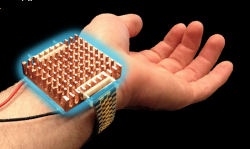
Wristify … a new thermoelectric bracelet out of MIT, monitors air and skin temperature, then sends tailored pulses of hot or cold waves to the wrist to help you maintain comfortable temps.Â
This experimental device helps the body adjust to accommodate temperature changes by applying hot or cold temperatures to the body through a wrist band:
If I put something cold directly on your body at a constant temperature, the body acclimates and no longer perceives it as cold. … Think of what happens when you jump in a lake. At first, it’s bracingly cold, but after a while, you get used to it. By continually introducing that sudden jolt of cold, Shames discovered, you could essentially trick the body into feeling cold. Wristify basically makes you feel like you’re continually jumping into the lake — or submerging into a hot bath.
This seems like a great use of sensors teamed with actuators, transforming contextual knowledge (ambient temperature) into useful response (thermal comfort).
Will we soon see a wearable device to help us endure to or cold temperatures? I don’t know, but this could be really useful. Apple or Google, could you please build this into a smart watch?
Albert Einstein is credited with saying “Insanity is doing something over and over expecting different results.” I tend to do that – lapsing into familiar behavior patterns that I know through experience don’t produce desired results.Â
Last Sunday morning, as I awoke from elusive dreams I can’t remember, I had these words running through my head: “Look, think and act differently.” Inspired advice? For me, it was.
I need to embrace change and look at challenges in my life differently, think about them differently, and act differently to overcome them.
For example, I know that sitting on the living room sofa alone in the evening watching some dumb cop show triggers insatiable hunger. I have experienced that over and over and over. I need to change that behavior. I am always less hungry when I am productively engaged in a meaningful project that focuses my mind away from food.
Professionally, I too often accept the status quo as the preferred approach. I must not be satisfied with the ways things have been. Â I need to look for new, creative solutions, different ways of doing things that deliver better results. Â I must be a catalyst for change, not someone along for the ride.
When I get back home from my current business trip, I am going to make a big sign like the little one above. Then, I am going to follow this advice. I am going to change. I want success, not insanity. Care to join me?
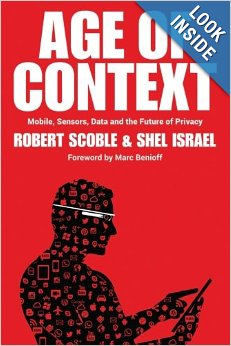
This evening, I finished reading a fascinating book, “Age of Context: Mobile, Sensors, Data and the Future of Privacy,” by Robert Scoble and Shel Israel.
Scoble and Israel propose that we are in the midst of a perfect storm:
Our perfect storm is composed not of three forces, but five, and they are technological rather than meteorological: mobile devices, social media, big data, sensors and location-based services. … they’re already causing disruption and making waves. As discrete entities, each force is already part of your life. Together, they have created the conditions for an unstoppable perfect storm of epic proportion: the Age of Context.
I have long been fascinated with the concept of context. I first mentioned context as an important factor in Identity Management in July, 2005, as I blogged about the Catalyst Conference.  During my years with Sun Microsystems, we often spoke about “context-aware, blended services” being delivered via mobile devices.  For example, in September, 2008, one of my blog posts entitled, “Sensor-triggered Personalized Services,” stated, in part:
Project Destination, an initiative I lead for Sun, is all about providing the infrastructure to deliver highly personalized, context-aware, blended services to online users across the “screens of your life.†When you couple sensor technologies with Identity, personalization and service orchestration techniques, you can get some powerful results.
It is great to see the progression and refinement of that concept. Â I sense we are barely scratching the surface of possibilities in this arena. Â Lot of fun ahead!
Fifteen years ago today, at age 77, John Glenn became the oldest man to go into space, as Payload Specialist for space shuttle Discovery.  It had been over 36 years since he had become the first American to orbit the earth aboard the Mercury Friendship 7 space capsule.  I remember sitting in my aunt’s living room in Salt Lake City listening with excitement to the radio as John Glenn circled the earth.

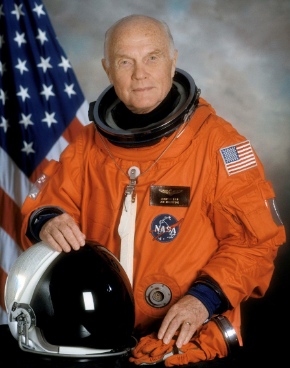
I have 17 years left before I’ll be 77. Lots of time yet in my life to do great things!
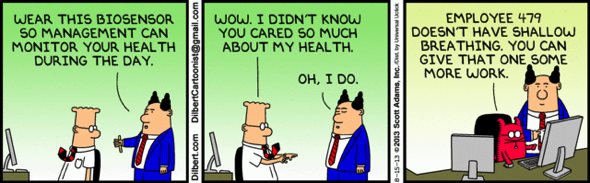
After all the hype I heard this week about the Internet of Things, perhaps this Dilbert strip from mid August puts things into perspective – a use case for Supervisory Control enabled by the Internet of Things.