[Log In] []

Exploring the science and magic of Identity and Access Management
Saturday, December 20, 2025

#SquareTag Experiment – Take 2

Identity
Author: Mark Dixon
Monday, March 18, 2013
7:58 pm

Squaretag4

Last Saturday, as my previous post described, I launched a little experiment by SquareTagging my blog. I had to make a few adjustments as I received some responses back from the kind folks who participated in the experiment.  Thanks to Phil Windley who was very helpful in answering questions and connecting me with a couple of the Kynetx developers.

It was fun to get responses from five states (Arizona, California, Idaho, Nebraska and Utah). Thanks to all of you who scanned or clicked on the SquareTag.

I have begun to formulate in my mind a blog post or two about personal clouds, based on this experiment.  Please stay tuned for more

If you haven’t done so, could you please scan or click on the SquareTag in this post or in the header of the blog?  I’d really appreciate it.

Thanks,

Mark


Blog Tagging with #SquareTag

Identity
Author: Mark Dixon
Saturday, March 16, 2013
10:44 am

Squaretag4I received my first order of SquareTag labels this week and tagged the normal things – iPad, briefcase, etc. It was fun to see that when a tag was scanned, the SquareTag “SafeAndMine” system sent me a geotagged message indicating where the scan had taken place.

In the wee hours of this morning, during a bout of insomnia, I had a brainstorm – why not SquareTag my blog? So, here it is. Please scan the SquareTag label, in this post or in the blog header, and send me a short message. It would be great to see who tagged me and where you are located. I’ll report back with the results.

One caveat … when you scan my tag, you will get a message from SquareTag saying, “You’ve found my Other.” The good folks at Kynetx didn’t anticipate this little experiment, so my blog is, at least for now, an “Other”.

Thanks – and good tagging!

Comments Off on Blog Tagging with #SquareTag . Permalink . Trackback URL
 

Of Piggy Banks and Mobility – Oracle White Paper

Identity, Information Security
Author: Mark Dixon
Saturday, March 16, 2013
6:58 am

Piggybank

Oracle recently released a white paper entitled, “Oracle Access Manager Mobile and Social, A Case Study – Piggy Bank.”  This white paper outlines the use of the Mobile and Social component of the Oracle Access Management platform.  Mobile and Social provides a simple means to integrate Mobile applications with the security capabilities provided by Oracle’s Identity and Access Management platform.

The white paper:

discusses the effort involved in executing a Proof of Concept with a major international bank. While the PoC exercise was real and the requirements described in this paper implemented, certain details have been changed to protect the identity of the bank and its security architecture and simplified for those new to OAM Mobile and Social.

The Proof of Concept detailed in this white paper involved three main tasks:

  1. creating a simple electronic banking application
  2. the REST/JSON services for the application
  3. securing the application and services with the Oracle IAM technology stack.

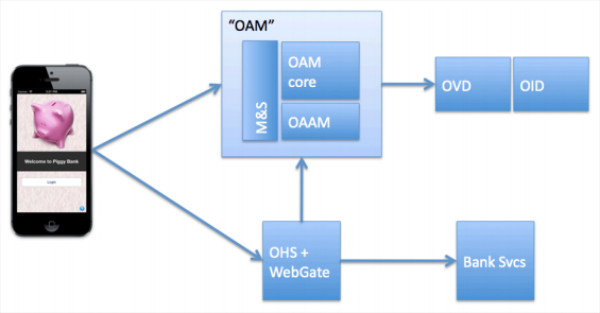
The “Piggy Bank” represents the bank for which the Proof of Concept was completed.  The basic PoC architecture is shown below:

Mobilesocial


The white paper does a good job of outlining just what is necessary to configure the components in this architecture.

The white paper concludes:

While the PiggyBank application is quite simple, it illustrates the power and capabilities of the Oracle Identity and Access Management platform including Oracle Access Manager, Oracle Adaptive Access Manager and some of the Mobile and Social Services. By using the OAM Mobile and Social SDK a fully functional mobile e-Banking application was created and secured in a very short time, without the need to install and configure any additional software and without the need to write complex code to secure the mobile App and its communication to the services it uses. 

A customer with an existing security infrastructure based on Oracle Access Manager and Adaptive Access Manager can easily deploy Oracle Mobile and Social to extend the same security capabilities to mobile applications. By using the Mobile and Social SDK customers can seamlessly integrate security into their native Apps on popular mobile platforms including iOS and Android.

The need for secure mobile access is already huge and growing rapidly.   The Oracle Mobile and Social product goes a long way towards meeting that demand.


Comments Off on Of Piggy Banks and Mobility – Oracle White Paper . Permalink . Trackback URL
WordPress Tags: , ,
 

New Oracle Security in Depth Reference Architecture

Information Security
Author: Mark Dixon
Friday, March 15, 2013
5:48 pm

Securityarch

This week, Oracle published a new white paper, “Security in Depth Reference Architecture,” authored by Dave Chappelle as part of Oracle’s Global Enterprise Architecture Program.

The executive overview includes this statement:

The traditional approach of securing the IT infrastructure is no longer enough. Today’s threats are multifaceted and often persistent, and traditional network perimeter security controls cannot effectively mitigate them. Organizations need to implement more effective, multi-level security controls that are embedded with their electronic assets. They need to take a holistic approach to protect systems starting with sensitive applications and data. And, they need to protect these key assets from both external and internal threats.

The conclusion states, in part:

Oracle’s security in depth architecture helps you prevent, detect, and respond to threats. It focuses on the most vital asset – your data. It starts from deep within the organization, protecting data at rest, in use, and in transit. It combines robust, proven application and database platform security, the latest in standards and technologies, versatile security services, and advanced monitoring and management capabilities, to produce a secure and cost effective solution.

The architecture presented in this paper provides a blueprint for security. It follows the most widely adopted security principles and best practices, and it describes a scalable architecture that addresses aspects of security that are critical to all organizations – data security, fraud detection, and regulatory compliance.

I hope you enjoy the white paper.  If you’d like to discuss, please let me know.

Comments Off on New Oracle Security in Depth Reference Architecture . Permalink . Trackback URL
WordPress Tags:
 

#MobileIDM Tweet Chat Archive

Identity
Author: Mark Dixon
Friday, March 15, 2013
4:57 pm

MobileidmLast Week, on Thursday, March 7th, the second @OracleIDM Tweet Chat (AKA Tweet Jam) was held. It was great to participate with many others on this lively and informative chat. The Chat Archive for #MobileIDM has been posted here for review.

Comments Off on #MobileIDM Tweet Chat Archive . Permalink . Trackback URL
 

Happy Pi Day!

General
Author: Mark Dixon
Thursday, March 14, 2013
9:57 am

In honor of 3/14, Pi Day, please take a minute and enjoy the Pi song with me …

Comments Off on Happy Pi Day! . Permalink . Trackback URL
WordPress Tags:
 

Big Data Analytics – Subtle Patterns and Relationships

Identity
Author: Mark Dixon
Thursday, March 14, 2013
8:55 am

Like

A recent Wall Street Journal article, “When ‘Likes’ Can Shed Light,” stated:

Patterns of “Likes” posted by people on Facebook can unintentionally expose their political and religious views, drug use, divorce and sexual orientation …

My first response was, “Duh, of course!”  But I think the implications are much deeper.  A wide range of disparate conditions can be linked together to imply seemingly distant results.  For example:

“Likes” for Austin, Texas; “Big Momma” movies; and the statement “Relationships Should Be Between Two People Not the Whole Universe” were among a set of 10 choices that, combined, predicted drug use. 

“Likes” for swimming, chocolate-chip cookie-dough ice cream and “Sliding On Floors with Your Socks On” were part of a pattern predicting that a person didn’t use drugs.

What in the world do all those things have to do with each other?
 
The article suggests that this type of analysis …
… arises from an emerging discipline in which experts sift through extremely large digital data sets, such as collections of web searches or Twitter messages, for subtle patterns and relationships.
“Subtle Patterns and Relationships” is the key phrase.  In our highly connected world, we all leave digital breadcrumbs scattered about that are subject to this type of analysis.  Sophisticated data analytics will progressively be able to pinpoint behavior patterns and even predict behavior, based on relationships between seemingly disparate and unrelated bits of data.
 
Will this be used to do a better job of targeting advertising?  If so, that might be beneficial to vendors and consumers alike.
 
But could it be used for nefarious purposes – even harassment, stalking, exploitation or discrimination?  You bet.  We had best be careful out there.
Comments Off on Big Data Analytics – Subtle Patterns and Relationships . Permalink . Trackback URL
WordPress Tags: ,
 

New Stuff on the Blog

Blogging
Author: Mark Dixon
Wednesday, March 13, 2013
5:18 pm

About a month ago, I began in earnest to renew my commitment to blogging.  Since then, I have been much more diligent in posting to this Discovering Identity blog.  Yesterday and today, I made a few long-overdue adjustments to the structure of the blog.

I added the following buttons so visitors can more easily post links for individual blog posts to Twitter, LinkedIn and Google+, with the option of using Buffer to delay the post to a later time if desired:

New1

You can now link to the social networking sites I pay attention to via icons on the sidebar:

New2

A couple of months ago, I started sharing some photos on SmugMug.  The SmugMug photo bar in the right sidebar gives you a glimpse of some of the photos I have shared.

New3

Comments Off on New Stuff on the Blog . Permalink . Trackback URL
WordPress Tags: ,
 

Identity Relationship Diagrams

Identity
Author: Mark Dixon
Wednesday, March 13, 2013
2:37 pm

Searching back through the archives, I realized that I had first used the term “Identity Relationship Diagram” in a blog post on July 21, 2005. I stated then:

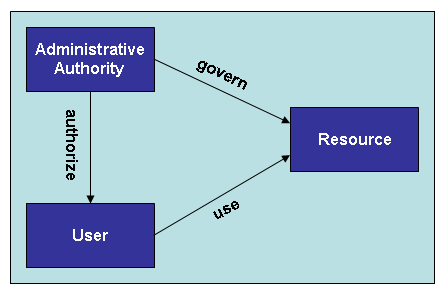
In the discipline of database design, Entity Relationship diagrams are used to diagram database schemas. In a database, neither entity nor relationship is complete without the other. It is the definition of relationship between data elements that adds value – hence the pervasive utility of the relational database.

A simple “Identity Relationship Diagram” (my term) helps to illustrate the concept. Identities are shown in boxes; relationships are shown as arrows.
IRD

More recently, following Ian Glazer’s proposal that graph databases replace directories and relational databases in Identity systems, I discussed using directed graph diagrams to illustrate identities and relationships:

We can visualize identities as nodes, each with relevant properties, and relationships between identities as edges.  Interestingly, the edges, or relationships, may also have identities and properties of their own.  

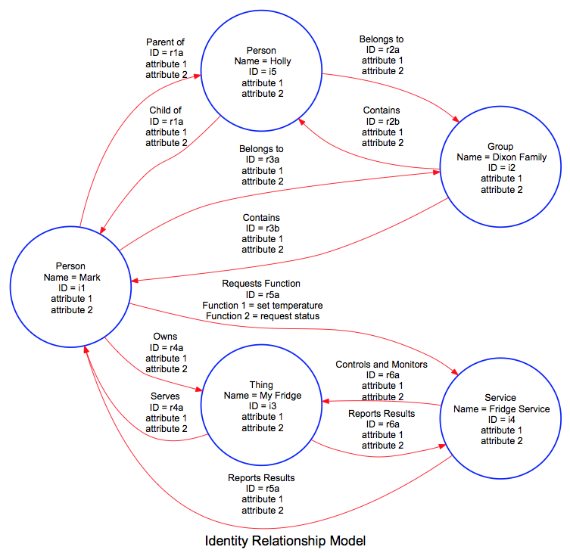
After further study and thought, I believe that “Identity Relationship Diagrams” can be very useful in illustrating concepts in the Identity and Access Management domain. The following diagram, prepared using Graphviz graph visualization software, is helpful to illustrate two general areas of discussion.
IRM1

The top half of the diagram illustrates basic relationships between individuals how those individuals can belong to groups.  This is the basic construct of the Facebook Identity Graph.

The bottom half of the diagram illustrates how people interact with things via services.  These are the basic elements in the Internet of Things.

My thoughts about how to use this diagramming method are still developing.  Stay tuned for more.

PS.  For those interested in trying out the Graphvis software, the Dot graph description language code to create this diagram is:

## Entity Relationship Diagram – prepared by Mark Dixon

digraph test {

rankdir=LR;

graph [ fontname = “Arial”, fontsize = 20, size = “20,10” ];
node [shape=circle,fixedsize=true,width=2.5,color=blue,style=bold, fontname = “Arial”];
edge [color=red, fontname = “Arial”];

i1 [ label=”Person\n Name = Mark\n ID = i1\n hair color = white\n residence = US”];
i2 [ label=”Group\n Name = Dixon Family\n ID = i2\n attribute 1\n attribute 2″];
i3 [ label=”Thing\n Name = My Fridge\n ID = i3\n attribute 1\n attribute 2″];
i4 [ label=”Service\n Name = Fridge Service\n ID = i4\n attribute 1\n attribute 2″];
i5 [ label=”Person\n Name = Holly\n ID = i5\n hair color = brown\n residence = UK”];

i1->i5 [ label = “Parent of\n ID = r1a\n attribute 1\n attribute 2” ];
i5->i1 [ label = “Child of\n ID = r1a\n attribute 1\n attribute 2” ];

i5->i2 [ label = “Belongs to\n ID = r2a\n attribute 1\n attribute 2” ];
i2->i5 [ label = “Contains\n ID = r2b\n attribute 1\n attribute 2” ];

i1->i2 [ label = “Belongs to\n ID = r3a\n attribute 1\n attribute 2” ];
i2->i1 [ label = “Contains\n ID = r3b\n attribute 1\n attribute 2” ];

i1->i3 [ label = “Owns\n ID = r4a\n attribute 1\n attribute 2” ];
i3->i1 [ label = “Serves\n ID = r4a\n attribute 1\n attribute 2” ];

i4->i3 [ label = “Controls and Monitors\n ID = r6a\n attribute 1\n attribute 2” ];
i3->i4 [ label = “Reports Results\n ID = r6a\n attribute 1\n attribute 2” ];

i1->i4 [ label = “Requests Function\n ID = r5a\n Function 1 = set temperature\n Function 2 = request status” ];
i4->i1 [ label = “Reports Results\n ID = r5a\n attribute 1\n attribute 2” ];


overlap=false
label=”Identity Relationship Model”

}

Comments Off on Identity Relationship Diagrams . Permalink . Trackback URL
 

AC/DC: The Tesla–Edison Feud

General
Author: Mark Dixon
Wednesday, March 13, 2013
3:58 am

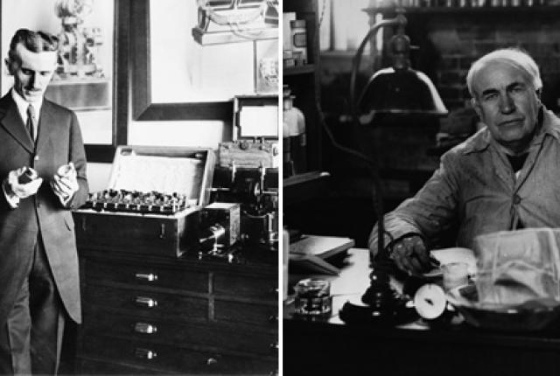
Two of the great minds in the history of electricity were featured in a recent article in Mental Floss.  These two men, giants in their field, were closely related in their work, but diametrically opposed in so many ways.  This short, but fascinating article gives a good overview of the feud between them.

Edison tesla 12

Comments Off on AC/DC: The Tesla–Edison Feud . Permalink . Trackback URL
WordPress Tags: , , ,
 
Copyright © 2005-2016, Mark G. Dixon. All Rights Reserved.
Powered by WordPress.