[Log In] []

Exploring the science and magic of Identity and Access Management
Friday, December 5, 2025

Project Morpheus: Safe Landing

Space Travel
Author: Mark Dixon
Friday, May 30, 2014
8:01 am

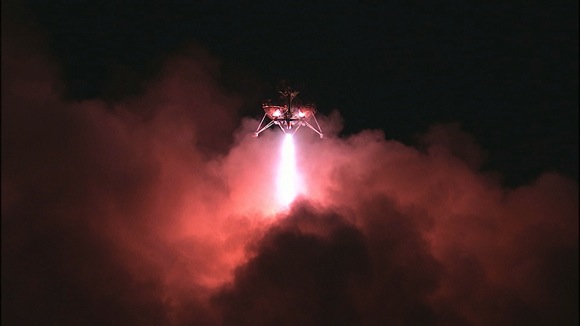
I love this photo that dropped into my email box this morning.  According to the NASA News Services:

NASA demonstrated that it can land an unmanned spacecraft on a rugged planetary surface in the pitch dark in a May 28, 2014 free-flight test of the Morpheus prototype lander and Autonomous Landing Hazard Avoidance Technology, or ALHAT. 

Morpheus

Further explanation from NASA:

Project Morpheus tests NASA’s ALHAT and an engine that runs on liquid oxygen and methane, which are green propellants. These new capabilities could be used in future efforts to deliver cargo to planetary surfaces. The landing facility provides the lander with the kind of field necessary for realistic testing, complete with rocks, craters and hazards to avoid. Morpheus’ ALHAT payload allows it to navigate to clear landing sites amidst rocks, craters and other hazards during its descent.

Comments Off on Project Morpheus: Safe Landing . Permalink . Trackback URL
WordPress Tags:
 

Thank You, Valiant Soldiers, for Preserving our Freedom!

Yellow Jeep Journey
Author: Mark Dixon
Monday, May 26, 2014
12:37 pm

May I raise my voice with countless others on this Memorial Day to pay tribute to valiant soldiers who fought and often died to preserve the freedoms we enjoy.

Roosevelt

I found this photo on a blog post that referenced an article by a British war correspondent embedded with the American army. He reported on the GI battle uniforms, vehicles, equipment and supplies.  His comment on the American Jeeps:

The jeeps … were unmatched, and the Germans loved to capture them for their own use.”

It appears that this photo is of President Roosevelt visiting the US troops. Quite the presidential limousine, don’t you think?

Again, thank you, thank you soldiers, for your valiant service, for a job well done.

Roll on Yellow Jeep Journey!

Comments Off on Thank You, Valiant Soldiers, for Preserving our Freedom! . Permalink . Trackback URL
WordPress Tags: ,
 

#IoT for Employee Management

Identity, Internet of Things
Author: Mark Dixon
Monday, May 12, 2014
4:27 pm

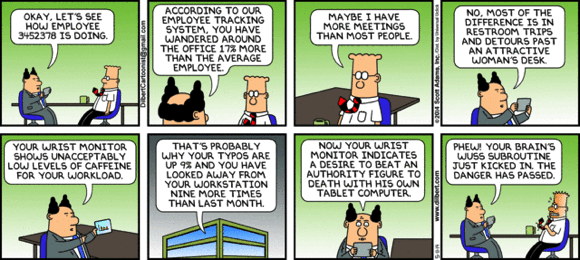
Ready to monitor, track and analyze employee behavior using the latest IoT technology?  Just ask Dilbert (aka Employee 3452378).

Dilbert 140511

Comments Off on #IoT for Employee Management . Permalink . Trackback URL
WordPress Tags: ,
 

Value of #IoT in Public Sector

Internet of Things
Author: Mark Dixon
Monday, May 12, 2014
2:50 pm

SmartCity

The future of the Internet of Things will depend on how much real value can be realized from highly connected systems.  I enjoyed reading the Information Week article “Internet of Things: 8 Cost-Cutting Ideas for Government,” which reported on a Cisco study, “Internet of Everything: A $4.6 Trillion Public-Sector Opportunity:”

The virtual connection of data from people, processes, and things — the Internet of Things, or as Cisco calls it, the Internet of Everything (IOE) — promises a world of new economic opportunities. Now a new study has put a value on that opportunity and concludes that the public sector could see as much as $4.6 trillion in IOE-related savings and revenues worldwide over the next decade.

Eight areas with the most potential value are listed below, with potential 10-Year Value shown in parentheses:

  1. Smart Parking ($41billion)
  2. Water Management ($39 billion)
  3. Gas Monitoring ($69 billion)
  4. Chronic Disease Management ($146 billion)
  5. Road Pricing ($18 billion)
  6. Telework ($125 billion)
  7. Connected Learning ($258 billion)
  8. Connected Militarized Defense (1.5 trillion)

Those are big numbers!

The estimate is separate from $14.4 trillion in additional value Cisco predicts the private sector will derive from new efficiencies and services resulting from data linkages over the Internet.

“If you look back a decade from today at the impact of the Internet of Everything, I predict you will see it will be five to 10 times more impactful than the whole Internet has been today,” said Cisco CEO John Chambers

Whether or not Cisco is completely correct in its analysis is somewhat beside the point.  There are huge opportunities for innovation and application ahead of us.


Comments Off on Value of #IoT in Public Sector . Permalink . Trackback URL
WordPress Tags: ,
 

#YJJ Architecture: Vehicle Telematics

Internet of Things, Yellow Jeep Journey, YJJ Architecture
Author: Mark Dixon
Monday, April 28, 2014
2:26 pm

Having explored very high level architectures for both the vehicle and cloud  I will begin to review on this blog some currently available (or soon to be available) products that may fit somewhat into the structure I have outlined.  I don’t expect an exact fit, but this will help me to narrow my choices about what technologies I should test first.

Fuse01

The first is a forthcoming product from Kynetx  named Fuse   Kynetx claims that “Fuse combines a sensor, a mobile app and the Cloud to create a new experience around owning and using a car.” The system includes three basic parts:

  1. A device that plugs into the OBD II port on your car, has a GPS and cellular connection, and constantly stream data from your car.
  2. A mobile app for interacting with the data.
  3. A personal cloud platform, under the car owner’s control, where the data is stored and processed.

Phil Windley, founder and CEO of Kynetx and well-known author and innovator, posted an interesting article on his blog yesterday: “Fuse is a Telemetrics Platform for Your Car: Trips on Your Calendar.”

I particularly like three things about the Fuse approach:

  1. The ODB II monitoring device has both cellular and GPS connections, allowing it to monitor the vehicle while the driver is not in it.  Other devices I have seen require the driver’s smartphone to provide connectivity beyond the vehicle.
  2. The Personal Cloud Platform from Kynetx is an innovative approach to providing a repository and programmable functionality in a highly personalized, privacy-protected manner.  While this approach is quite different than the enterprise-centric architecture proposed by Oracle, it may be better suited for my Yellow Jeep Journey objectives.
  3. Fuse will have a published event-driven API to access and manipulate functionality.

I don’t know if it will allow other inputs from the vehicle that are not available through the ODB II port interface.  Sensors like GPS, accelerometers, magnetometers, etc., may require a separate interface.

I pre-ordered a couple of the Fuse devices during its Kickstarter campaign a couple of months ago.  I anxiously await delivery, which should be in about 2 months.

Comments Off on #YJJ Architecture: Vehicle Telematics . Permalink . Trackback URL
WordPress Tags: , ,
 

#YJJ Architecture: Services in the Cloud

Yellow Jeep Journey, YJJ Architecture
Author: Mark Dixon
Wednesday, April 23, 2014
6:42 pm

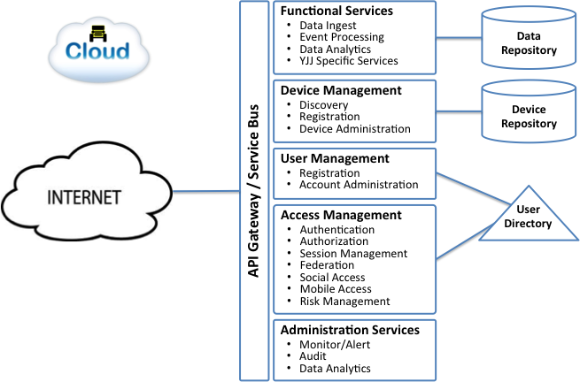
On April 5th, I posted a high level architecture diagram of sensors, subsystem controllers, gateway and supporting functions that will need to exist on the Jeep.  Today’s post offers a high level diagram of functionality that should exist in the Yellow Jeep Cloud. This roughly follows the structure of the Oracle IoT Platform I described in my March 22nd post.
YJJCloud01


One basic design objective is that all functions will be exposed as secure API’s that could be consumed by web apps or mobile apps as needed.  Therefore, the primary interface to the open Internet is a secure API gateway.  This may operate in conjunction with an enterprise service bus that manages a catalog of available services and API’s.

For the purpose of this post, available services are divided into five major categories, with three major data repositories:

First, the data repositories:

Data Repository.  This is the database where all data from the Jeep (or many Jeeps) will be collected and stored for functional processing or analysis.

Device Repository.  This database will be used to maintain a complete catalog of all available and used devices, along with capabilities pertaining to each device.

User Directory.  This directory will be used to maintain all users, access rights and credentials necessary to access data services and applications in the YJJ cloud.

Now, the functional elements:

Functional Services.  These services are really the focal point of the YJJ cloud.  It is this functionality that will make the the data collected and used from the Jeeps used.  Some functions may be quite generic, such as data ingest, event processing and data analytics, but I anticipate that a set of #YJJ-specifc services (yet to be defined) will be the most important set of functions in this group.

Device Management.  A complete catalog of devices authorized to connect to the YJJ Cloud will need to be maintained, and secure access rules enforced.  Functions to discover, register and manage changes to this large network of devices will be required.

User Management.  All users that will access YJJ data, services, APIs or applications will need to be registered and access rights be appropriately granted.  

Access Management. Access Management or Control functionality will be needed to enforce security polity for application access by users as well as to secure the APIs that can be used by external applications for accessing YJJ functionality.

Administration Services.  Common administration services will be needed to monitor the health of system components and provide auditing and reporting functions.

This provides a very high level view of my thoughts for YJJ Cloud functionality.  Much more definition is needed for each set of services.  Stay tuned!

Roll on Yellow Jeep Journey!


Comments Off on #YJJ Architecture: Services in the Cloud . Permalink . Trackback URL
WordPress Tags:
 

#YJJ Architecture: Devices on the Jeep

Yellow Jeep Journey, YJJ Architecture
Author: Mark Dixon
Friday, April 4, 2014
2:10 pm

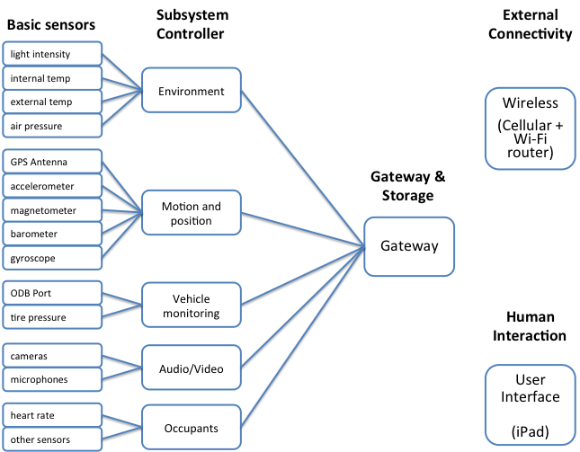
The following diagram illustrates how the the sensors I proposed would map onto the general Oracle Internet of Things reference architecture I recently discussed.

At the first level, this diagram shows possible raw sensors and the device controllers responsible for configuring and monitoring the sensors.  The gateway device would aggregate the data and forward that data in either raw or summarized form to the data ingest function in the cloud.  Intermediate storage at the gateway level would allow the Jeep to continue to operate in cases where wireless communication is not available.  The gateway would also provide local APIs what could be consumed by a user interface app on an iPad via Wi-Fi connection.

JeepSensors01

Of course, a lot more detail is needed.  Each little subsystem could become quite complex. What fun!

Roll on Yellow Jeep Journey!


Comments Off on #YJJ Architecture: Devices on the Jeep . Permalink . Trackback URL
WordPress Tags:
 

#YJJ Architecture: Psychokinetic Energy Sensor

Yellow Jeep Journey, YJJ Architecture
Author: Mark Dixon
Tuesday, April 1, 2014
5:04 pm

PKE

Today, I learned of a new sensor I will absolutely need to add to the #YJJ Architecture instrumentation list  The IPSO Alliance announced a new Psychokinetc Energy (PKE) smart sensor:

This new product will allow consumers to remotely monitor paranormal activity in their home and work environments. It is currently under patent review.

Boy, this new sensor should help to identify the ghosts of old Willys Jeeps that might be hanging around and help ferret out mysterious, phantom engine anomalies! The Internet of Things may have just crossed over into the Twilight Zone!

The sensor comes with an impressive list of product features:

  • Unprecedented sensitivity – up to 300 meter detection zone
  • Quadcore technology – track multiple entities simultaneously
  • Astral Positioning System enables real time map tracking/Google maps overlay
  • Connecting multiple systems enables wider coverage
  • Sends alerts via SMS and Twitter to avoid supranatural interference
  • False positive detection software filters out non psychokinetic activity
  • Internet enabled
  • iPhoneâ„¢/Androidâ„¢ Applications
  • IPv6 compatibility
  • Supports optional Home Entity Management System (HEMS)
  • Google Glassâ„¢ and IP-based actuator interfaces: sense activity, record and share

For more information, please contact:

  • Laff Sonyu, IPSO Marketing Director (marketing@ipso-alliance.org)
  • Hugh Morris, Grid Connect Marketing Lead (marketing@gridconnect.com)

Roll on Yellow Jeep Journey!

Comments Off on #YJJ Architecture: Psychokinetic Energy Sensor . Permalink . Trackback URL
WordPress Tags: ,
 

How Much Time Have You Wasted/Invested on Twitter?

Social Media
Author: Mark Dixon
Saturday, March 29, 2014
6:56 am

This happy little notice dropped in my email box this morning, claiming that my birthday was also the sixth anniversary of my joining Twitter.

Twitterversary


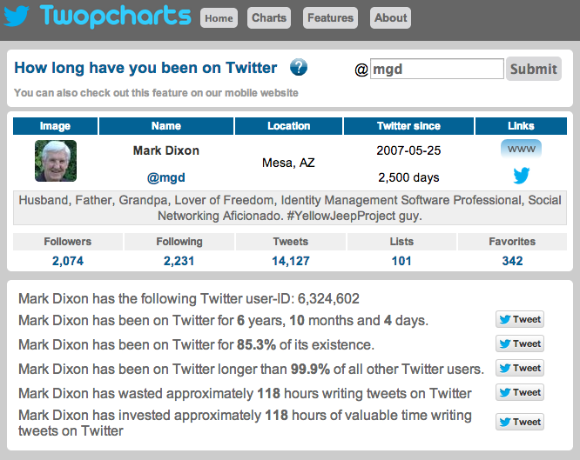
Actually, Twitter may need to adjust its email robot a bit.  Upon further investigation, with the help of the Twopcharts web site, I found more precise information:


Twopcharts

So, I have been on Twitter a total of 2,500 days (6 years, 10 months and 4 days).  Twitter was only 10 months late sending the Twitterversary message to me.

The burning question is: how much valuable time have you wasted or invested (depending on your point of view) posting tweets on Twitter?  Twopcharts estimates 118 hours for me!

Tweet on, my friends!

Comments Off on How Much Time Have You Wasted/Invested on Twitter? . Permalink . Trackback URL
WordPress Tags:
 

Social Media and Donuts

Social Media
Author: Mark Dixon
Friday, March 28, 2014
1:33 pm

Donut

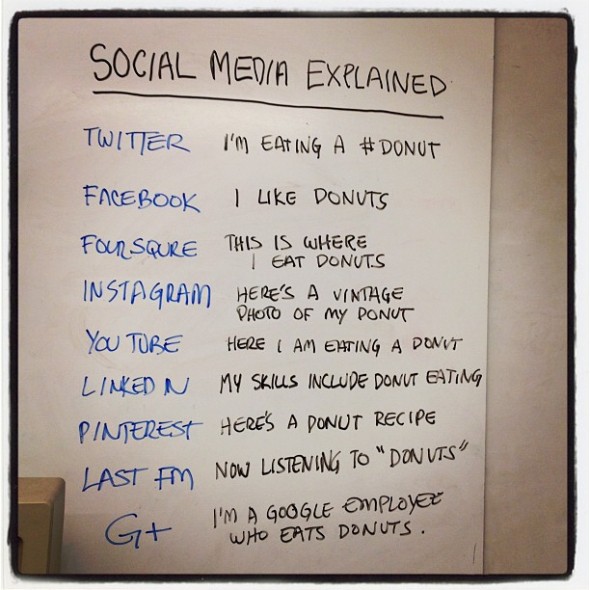
This morning, I stumbled upon a Facebook post that explained the different social media services in terms that even I could understand.  I think it originally came from geek.com.  Grab a donut and enjoy!

Social media donut 590x590

Comments Off on Social Media and Donuts . Permalink . Trackback URL
 
Copyright © 2005-2016, Mark G. Dixon. All Rights Reserved.
Powered by WordPress.