Lego Printer/Plotter

Pretty cool to see what can be done with Legos if you put your mind to it!
We have built lots of neat stuff with Legos at our house, but nothing quite this complex.

Pretty cool to see what can be done with Legos if you put your mind to it!
We have built lots of neat stuff with Legos at our house, but nothing quite this complex.
Earlier this week, BBC News published a short article about the bi-annual “Top 500 supercomputer list.†An interactive “tree map†created using Prefuse Flare software, developed by the University of California Berkeley, allows a user to easily see different views of the list, according to attributes such as speed, operating system, manufacturer and country (shown below).
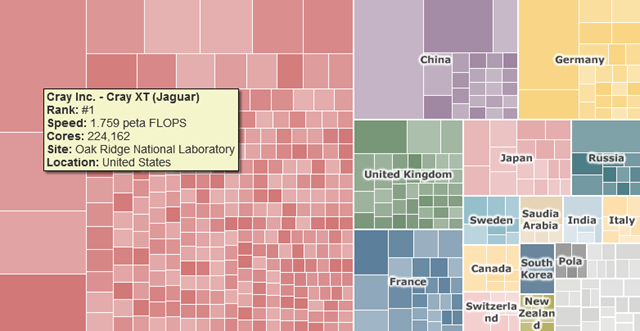
The number one supercomputer: Cray XT with a maximum speed of 1.759 peta FLOPS with a total of 224,162 cores (AMD processors running Linux). Crazy!
 First, the disclaimer: I grew up in the Magic Valley area of southern Idaho on a small dairy farm. Because of that, my worldview is often skewed in terms of Idaho milk cows.
This morning, IT World Canada reported,
“Researchers at Hewlett Packard Co.’s HP Labs presented a paper on using cow manure from dairy farms and cattle feedlots and other "digested farm waste" to generate electricity to an American Society of Mechanical Engineers conference held this week.
“In the paper, the research team calculates that "a hypothetical farm of 10,000 dairy cows" could power a 1 MW data center — or on the order of 1,000 servers.â€
So, it takes waste from 10 cows to fuel 1 server! I immediately thought of my Dad, a retired farmer who still lives in the Magic Valley area of Idaho. He once told me that the only thing growing faster than the number of cell phone towers in Magic Valley were the stacks of cow manure. That is probably due to the 382,214 dairy cows that lived in Magic Valley as of the latest report of the United Dairymen of Idaho.
With the ever-increasing overabundance of cow manure in Idaho, I was encouraged by the HP study. In all of Idaho, there are 532,353 milk cows – a ratio of roughly one cow for every three human residents (see Census Bureau)! This is enough cows to fuel 53,000 servers.
This could lead to Idaho being home to huge data centers, all powered by bovine effluent. If HP’s estimates are accurate, the current Idaho dairy cow population could fuel 53,000 power-hungry servers, all while increasing dairy farmers’ profit rate eliminating smelly piles of cow manure. A win-win-win for Magic Valley, I’m sure!
Plus, I know some Oracle reps who would love to sell that many servers (with all due respect to the HP study).
I received the following email forward from by brother-in-law this week. If the story isn’t true, it is quirky enough that it deserves to be:
Running stop light = $100.00
DUI = $5000.00
Not wearing a seat belt = $50.00
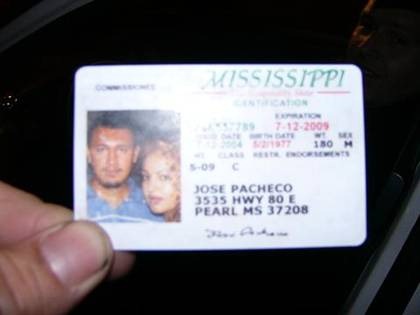
Putting you & your girlfriend on your fake drivers license = PRICELESS
REMEMBER!! When making a fake ID, attach a picture of yourself ONLY, no matter how much you love your girl. … This is an actual drivers license from a traffic stop.
 I had a conversation with a colleague this morning about the tension between two sales approaches:
Our unified position was that the the second position only really made sense if aligned with the first. Technology by itself is certainly interesting, but in real world markets, it is becoming increasingly difficult to justify purchase of any technology unless it is very clear how that technology can deliver business value.
Therefore I spend most of my time focused on the business value of various Identity and Security technologies, rather than the technical details of how they are implemented. Unless we can really make a positive impact on the business whom buy our products and services, our market is not sustainable.
 My former Sun colleague Brad Wheat just alerted me about an interesting service from Acxiom, “Identity-X Authenticateâ€:
According to Acxiom’s brief product description:
Verification is the process of substantiating that someone is in fact who he says he is, and verifying the validity of the information he has provided as authentic or genuine. Often times this is the first step in a risk management strategy. The Acxiom Identify-X Authenticate process uses unique data generated questions to identify an individual and then verifies these individuals through our high quality database, offering greater security to the end user.
Acxiom’s identification platform utilizes demographic and geographic data in challenge questions with nearly 900 data elements for more than 300 million individuals. Identify-X Authenticate data comes from public, publicly available and non-public proprietary databases. Identify-X Authenticate data is current and regularly updated daily, weekly and monthly, depending upon the data source.
Reading further in the product fact sheet, I discovered:
Examples of some of the data generated questions that Acxiom uses include:
- Based on your driver’s license do you wear corrective lenses?
- What professional licenses do you hold?
- What subdivision do you currently reside in?
- What state does your relative Joe live in?
- How many fireplaces did you have in your last residence?
Acxiom claims to leads the industry with a collection of more than 115 unique authentication
questions. I didn’t realize I knew that many answers myself!
When I visited the Acxiom corporate headquarters in Arkansas about a dozen years ago, they claimed to have data on 95% of the population of the United States. I think the coverage has grown in both depth and breadth by now.
This approach to authentication both encourages and unnerves me. On one hand, it appears to be an effective method to reduce fraudulent access to information and systems. On the other hand, it is more than a bit scary to realize that all this information about individuals resides in a single private database.
I just wonder … do they know what injury nearly killed me when I was four years old? Do you? Do you care?
 Dave Kearns indentified three separate focus areas for Identity and Cloud Computing in his Network World post today:
Identity-in-the-cloud, or Identity as a Service:
IdM services such as provisioning, governance, role management, compliance, etc. are hosted "in the cloud."
Identity-for-the-cloud:
Provisioning services for cloud apps provided by traditional, on-premise, provisioning vendors as well as other identity services (privileged user management, compliance, etc.) extended to the cloud from your data center.
Meshed, or integrated, on-premise/in-the-cloud:
Linking on-premises Identity Management infrastructure and cloud identity data from cloud-hosted applications.
More than anything, this points out that Identity Management and Cloud Computing is a multi-faceted issue. “Cloud†may refer to where the Identity Management services are hosted, as well as where the applications reside that consume Identity Management services – or a combination of both.
Certainly worth further exploration.
I dedicate a column in my laptop TweetDeck application to the search term “Identity Management.†It is enjoyable to scroll through now and then to see what folks have to say about this important topic. Tonight, I was intrigued by a tweet from @susanguarneri “Online Identity Management: Get Found! http://bit.ly/djdFRmâ€.
 It was interesting to find that Susan Guarneri, AKA the Career Assessment Goddess, defines Identity Management this way:
“Online identity management is career management for the employed and unemployed. Online identity management is also business management, particularly if your small business centers on you. Rather than waiting and hoping that your career or business future plays out successfully, why not take back control? Find out how you can get found online, differentiate yourself, and stand out positively from your competition.â€
 That is quite a bit different than what Wikipedia’s definition:
“Identity management or ID management is a broad administrative area that deals with identifying individuals in a system (such as a country, a network or an organization) and controlling the access to the resources in that system by placing restrictions on the established identities.â€
It all goes to show how different perspectives may yield different definitions. To Susan, Identity Management is all about taking control of one’s personal Identity in cyberspace. To the unknown Wikipedia author (by the way, that article is begging for a re-write), Identity Management is all about some organization controlling the Identities of others.
Both are valid viewpoints. It just pays to understand the perspective of each user of a phrase before passing judgment.
In response to my colleague, Jack Crail, who circulated the link to the video in my previous post, another colleague, Brad Diggs, responded:
Hey Jack,
No this isn’t an urban legend. I have been working up a blog post that gives folks a strategy for how to deal with it. I am the deacon of IT at my church and we have had to deal with it head on. For everyone’s benefit, your best friend in this is Darik’s Boot and Nuke. Of course the best thing is to make sure that the drive is not accessible by anyone that shouldn’t be accessing it. You also need to make sure that you pull the drive when ever you have it serviced, sell it or dispose of it.
Lastly, note that this risk applies to both photocopiers AND printers with internal print queues.
Have a great day!
Brad
Brad followed up that note with an excellent post on his blog recommending a step by step process to deal with the problem.
Thanks, Brad!
The thought never crossed my mind until my colleague Jack Crail sent me a link to this short CBS News video that outlines little-known security risks lurking in the background – hard drives in digital copier containing thousands of pages of sensitive information.
A companion print article highlighted a short study of four copiers detailed in the video:
The results were stunning: from the sex crimes unit there were detailed domestic violence complaints and a list of wanted sex offenders.
On a second machine from the Buffalo Police Narcotics Unit we found a list of targets in a major drug raid.
The third machine, from a New York construction company, spit out design plans for a building near Ground Zero in Manhattan; 95 pages of pay stubs with names, addresses and social security numbers; and $40,000 in copied checks.
But it wasn’t until hitting "print" on the fourth machine – from Affinity Health Plan, a New York insurance company, that we obtained the most disturbing documents: 300 pages of individual medical records. They included everything from drug prescriptions, to blood test results, to a cancer diagnosis. A potentially serious breach of federal privacy law.
Who knows how much of your personal information is floating out in never-never land on copier hard drives you may not have even known about?