[Log In] []

Exploring the science and magic of Identity and Access Management
Monday, December 22, 2025

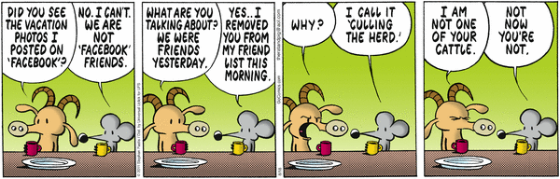
De-Friending or “Culling the Herd”?

Humor
Author: Mark Dixon
Thursday, August 18, 2011
8:48 pm

Back on the small Idaho dairy farm where I grew up, “Culling the Herd” meant sending cows that didn’t give much milk to the slaughterhouse to make way for more productive bovine.  I hadn’t heard the term referring to getting rid of Facebook friends until I read the “Pearls before Swine” comic strip today.  A bit crass, but sort of descriptive, don’t you think?

After posting this bit of irony, I suppose I’d better not de-friend anyone unless there is a darn good reason, don’t you think?

Comments Off on De-Friending or “Culling the Herd”? . Permalink . Trackback URL
WordPress Tags:
 

Happy Discovery: Weather in Google Maps

Technology
Author: Mark Dixon
Thursday, August 18, 2011
10:39 am

A Lifehacker tweet caught my eye this morning:

From the ‘why wasn’t this part of it before?’ files: weather in Google Maps lifehac.kr/rntesc

What a great addition to Google Maps! For one who travels frequently as I do, the weather overlay on Google Maps is a godsend. Many times during my career, I have showed up somewhere ill-equipped for the weather and had to buy a coat or sweatshirt to survive. Now, if I can only remember to look at Google Maps, I will be much better prepared.

I wonder when it will show up on my iPhone app?

By the way, do you want to visit us in Mesa, AZ? Maybe in November.


However, although the temperature outside is verifiably toasty, my wonderfully air conditioned office registers a mere 78 degrees!

Comments Off on Happy Discovery: Weather in Google Maps . Permalink . Trackback URL
WordPress Tags: ,
 

Oracle Unified Directory – Stepping Forward

Identity
Author: Mark Dixon
Thursday, August 18, 2011
8:57 am

Back on July 20th, Oracle officially announced Oracle Unified Directory 11g, although it had “unofficially” been available for download for quite some time before that date.  I was part of the Oracle Security Sales Consulting team who received training on this new product the week of July 11th, the week before the official launch.

As a former Sun Microsystems employee, it is gratifying to see Oracle leverage the excellent innovation in the OpenDS project into a full-fledged strategic product. Now, from its humble origins OUD has emerged as the “Next-Generation Unified Directory Solution that Integrates Storage, Synchronization and Proxy.”  Some key highlights include:

  • Next Generation: builds on the success and wide adoption of Oracle’s existing directory services solutions with five years of continuous and innovative development to address the increasing demands on modern directory servers;
  • High Volume Writes: utilizes social and location-based services to increase the frequency of changes to identity data, as well as expanding the contents to include more details, including location, images, and relationships;
  • Elastic Scalability and Extreme Performance: provides a global index and data distribution capabilities to deliver unmatched elastic horizontal scalability and offers high-scale authentication performance to serve an unparalleled billions of users, subscribers and devices;
  • On-premise and Cloud Computing Capabilities: controls the synchronization and virtualization of the data to make data available to cloud-based applications and systems while protecting data privacy and data jurisdiction across organizational and state boundaries;
  • Smaller footprint: makes Oracle Unified Directory simple to embed and easy to deploy and manage;
  • Integrated: interoperates with all components of Oracle Fusion Middleware 11g and Oracle Directory Services Plus Suite, while still providing standards support for application integration and scalable data management in heterogeneous environments. Additionally, it also integrates with Oracle Enterprise Manager for monitoring and Oracle Directory Services Manager for configuration.
You can see an on-demand webcast introducing Oracle Unified Directory, download a data sheet for overview information, or dive more deeply.

By the way, I couldn’t find an OUG-specific graphic to use in this post.  Sun Microsystems was a bit more fun in that regard!

Comments Off on Oracle Unified Directory – Stepping Forward . Permalink . Trackback URL
WordPress Tags:
 

Chad Russell – Welcome to the Blogosphere!

Identity
Author: Mark Dixon
Thursday, August 18, 2011
8:12 am

I always enjoy learning about a new Identity Management blog. Today, please joining me in welcoming Chad Russell, an Oracle colleague and good friend who hails from the great state of Arkansas, into the blogsphere.  He recently launched a new Identity Management blog, “Brave New Identity – Identity Happenings from the Field.”  His last four posts are both relevant and interesting:

  • 3 Hot Trends in IDM (Part 1 of 3)
  • Why Provisioning Is Really An Authorization Problem
  • Auditing the Cloud
  • Amazon boosts IdM offering for cloud

I’m particularly looking forward to learning what Hot Trends 2 and 3 are.

You can also follow Chad on Twitter at @chadrussell_idm.

By the way, the young man up in the corner is Chad’s son, proclaiming, “Love the site, Pops!

Comments Off on Chad Russell – Welcome to the Blogosphere! . Permalink . Trackback URL
WordPress Tags: ,
 

Aberdeen Research Brief: Identity and Access Management – Platform vs. Point Solution

Identity
Author: Mark Dixon
Wednesday, August 17, 2011
9:22 pm

One of the big questions in modern Identity and Access Management continues to be: “Is it better to choose individual point solutions and integrate them in my enterprise, or should I choose a complete IAM platform?

I recently learned of an intriguing Research Brief published by the Aberdeen Group, entitled, “IAM Integrated: Analyzing the ‘Platform’ versus ‘Point Solution’ Approach.” Aberdeen’s conclusion:

Based on more than 160 respondents from its Managing Identities and Access study (February 2011), Aberdeen’s analysis of 32 enterprises which have adopted the vendor-integrated (Platform) approach to identity and access management, and 39 organizations which have adopted the enterprise- integrated (Point Solution) approach, showed that the vendor-integrated approach correlates with the realization of significant advantages.


The most significant advantages realized by organizations adopting the Platform approach to Identity and Access Management, as compared to those adopting the Point Solution approach, include:

  • Increased end-user productivity
  • Reduced risk
  • Increased agility
  • Enhanced security and compliance
  • Reduced total cost

Aberdeen’s research also confirmed the merits of a pragmatic “Crawl, Walk, Run” approach as the basic template for successful enterprise-wide initiatives involving Identity and Access Management, similar to what I have been recommending for years.

  • Adopt a primary strategic focus.
  • Put someone in charge.
  • Prioritize security control objectives as a function of requirements for risk, audit and compliance.
  • Establish consistent policies for end-user identities and end-user access to enterprise resources.
  • Standardize the workflow for the IAM lifecycle, including workflow-based approval for exceptions.
  • Standardize audit, analysis and reporting for IAM projects.
  • Evaluate and select IAM solutions.
Each element of this recommended approach is described more fully in the report.
I highly recommend that you download a copy of the report and review both the further detail and the methods Aberdeen used to arrive at its conclusion.
Comments Off on Aberdeen Research Brief: Identity and Access Management – Platform vs. Point Solution . Permalink . Trackback URL
 

Collective Intelligence and Global Democracy

Freedom
Author: Mark Dixon
Wednesday, August 17, 2011
4:26 am

I was intrigued with the following two tweets that appeared in my Twitter stream this morning, only three tweets apart in the stream:

From @newsbrooke: RT @johnmitchinson: ‘We could be on the cusp of a whole new global democracy” Another must read from @newsbrooke: bit.ly/mSXx0k

From @gartner_inc: Creativity, Social Exchange, & Collective Intelligence will Make the Future Better than past. gtnr.it/omppJE #GartnerPCC Summit.

The first referenced Heather Brooke, who spoke about the role of social media in the UK riots

There are always going to be new ways to communicate and a democratic society shouldn’t be afraid of that. That was the whole purpose of the First Amendment [to the US Constitution]. Free communication was never the enemy, it was the liberator. …

We could be on the cusp of a whole new global democracy, where individuals have incredible power or we  could become a global totalitarian society where all of us are under surveillance at all times.

The second tweet references a speech to be given by Matt Ridley at the Gartner Portals, Content & Collaboration Summit on September 21, 2011:

Matt Ridley argues that for most people in the world, the future is going to be inexorably better than the past for the following reasons. 1. Despite recessions and wars, human society has been getting wealthier, healthier, happier, cleverer, cleaner, freer, kinder, more peaceful and more equal. 2. Though we repeatedly expect this improvement to cease, yet it keeps defying the pessimists. 3. There is a reason that this happens – through exchange and specialization, a process that allows us to work efficiently for each other in an increasingly interdependent way that creates a sort of collective intelligence.

The two phrases that caught my attention were “global democracy” and “collective intelligence”.  I agree with Ms. Brooke that social networking does enhance the democratic voice of the people, and can be a powerful influence against totalitarianism.  The same phenomenon will contribute to our collective intelligence as we share ideas.   The challenge and opportunity is to sort through all the noise and ultimately find truth.

Back in 1995, following the advice of Stephen R. Covey, I established a personal mission statement.  One line in that statement is “Enhance Human Freedom through Global Electronic Communications.”  I like to think that my small participation in social media will indeed contribute to human freedom through sharing ideas in the ever-expanding network of people interconnected with global electronic communications.

Comments Off on Collective Intelligence and Global Democracy . Permalink . Trackback URL
WordPress Tags: , ,
 

Happy Discovery – Fluid Apps

Technology
Author: Mark Dixon
Wednesday, August 17, 2011
3:27 am

Yesterday, I got tired enough of Tweetdeck intermittently hanging while I tried to check my Twitter feeds that I started checking for an alternative.  I use the Hootsuite app on my iPad, so I checked to see if Hootsuite has a dedicated Mac client.  It doesn’t, favoring a browser-only user interface for Mac and PC.  However, in the search, I stumbled across a blog post by David Chan, outlining how to use Fluid to set Hootsuite up as an dock-able application.  Fluid “lets you create a Real Mac App (or “Fluid App”) out of any website or web application, effectively turning your favorite web apps into OS X desktop apps.”  It essentially dedicates a separate browser instance to each website.

So, I “Fluidized” Hootsuite and liked it so well that I did the same thing to the WordPress Dashboard, where I am writing this post.  I like the capability to have these “apps” in the Mac dock, and really like the ability to use Command-Tab to cycle between them like the rest of my apps. Who knows what my next Fluid App will be!


Comments Off on Happy Discovery – Fluid Apps . Permalink . Trackback URL
WordPress Tags: , , ,
 

What is Your Secret Identity?

Humor, Identity
Author: Mark Dixon
Thursday, August 4, 2011
6:44 am

Do you have a secret Identity, an alter-ego, a second (or third) personality manifesting itself secretively in cyberspace?  If so, you must be a superhero, according to Ziggy (aka Zigmeister), our ever-erudite philosopher.

Comments Off on What is Your Secret Identity? . Permalink . Trackback URL
WordPress Tags: ,
 

Scarce Interest in Verifying my Identity

Identity
Author: Mark Dixon
Friday, July 29, 2011
6:09 am

On December 10, 2009, I posted a short piece on this blog about Trufina, a company providing online identity verification services.  For a long time, I had a visible Trufina badge on the blog, so someone could click on it to verify that I was, indeed, the very Mark Dixon I claimed to be.  Since no one expressed interest, I took the badge off my main page.

Just this week, over 18 months later, one person actually clicked on the link in my December 2009 post and requested verification of my identity – not so much that he was interested in my identity as he was in the process of validating online identities.

I have concluded that this dearth of activity must have something to do with the following:

  1. My blog is rarely read.
  2. People aren’t interested in Trufina.
  3. People just don’t care about validation of online identities.
  4. A combination of the above.

By the way, I have never received a single request from someone via Tru.ly, the similar service whose badge I now display on the right most column of this blog. But I must be patient.  I just signed up for Tru.ly in March, 2011.  I have 14 more months before I can really compare the popularity of Tru.ly and Trufina.


Affinity for Obsolete Old Things

Humor, Technology
Author: Mark Dixon
Friday, July 22, 2011
4:16 pm

All our married kids have at least 1 HDTV system in their homes – one son has four!  But their “stuck-in-the-dark-ages” dad still has the same old reliable Sony flat screen 36″ set that was state-of-the-art back in 1997.  I can really identify with Earl Pickles.

And yes, Opal, I may also be an obsolete old thing.

But seriously, when we break down and buy a new HDTV system later this year, what on earth should we do with the Trinitron?  Give it to Earl?

By the way, the ghostly image in the screen is not me bowing in obeisance to the TV Gods.  I am just taking a photo for this blog.

Comments Off on Affinity for Obsolete Old Things . Permalink . Trackback URL
WordPress Tags: ,
 
Copyright © 2005-2016, Mark G. Dixon. All Rights Reserved.
Powered by WordPress.