[Log In] []

Exploring the science and magic of Identity and Access Management
Sunday, December 21, 2025

My Top-Ten List of Concept Words

General
Author: Mark Dixon
Saturday, May 19, 2012
4:58 pm

Sound of MusicMaria von Trapp, please meet David Letterman and Merriam-Webster.  You have often graced us with your uplifting song, “… these are a few of my favorite things.” May I share with you a top-ten list of my favorite words, each the embodiment of a profound concept I cherish in my life?


  1. Life
  2. Freedom
  3. Light
  4. Faith
  5. Integrity
  6. Infinity
  7. Identity
  8. Innovation 
  9. Compassion
  10. Redemption

As often is the case, I find brevity to be more difficult than verbosity.  I place high value on many more concepts, but for today’s few moments of personal introspection, here is my short list.  What’s yours?

Comments Off on My Top-Ten List of Concept Words . Permalink . Trackback URL
WordPress Tags: , ,
 

The Most Asymmetrical Aircraft Ever Made

Leadership
Author: Mark Dixon
Saturday, May 19, 2012
11:30 am

The photo below is of the Blohm & Voss 141, a concept aircraft produced for the the German air force, or Luftwaffe, during World War II. Despite its several advantages for the tactical reconnaissance role for which it was commissioned, this airplane “didn’t make sense to the German High Command, possibly simply because of its appearance,” dooming the project.

BF 141

Talk about trying to stuff square pegs into round holes!

Comments Off on The Most Asymmetrical Aircraft Ever Made . Permalink . Trackback URL
WordPress Tags:
 

Think Different!

Leadership
Author: Mark Dixon
Saturday, May 19, 2012
11:00 am

Yesterday, after I posted about square pegs in round holes, my daughter sent me the classic “Think Different” quote embodied in this video:

Interestingly enough, the video talks of “round pegs in square holes,” not the other way around as the idiom was originally conceived. How apropos! Think different(ly)!

Comments Off on Think Different! . Permalink . Trackback URL
WordPress Tags: , ,
 

Square Pegs and Round Holes

Leadership
Author: Mark Dixon
Friday, May 18, 2012
3:12 pm

Square Peg; Round HoleDid you ever wonder where the term “square peg in a round hole” came from?  According to Wikipedia, the term first appeared a book by British novelist Edward Bulwer Lytton his late 19th century book, Kenelm Chillingly, His Adventures and Opinions:

Kenelm Chillingly asks, “Does it not prove that no man, however wise, is a good judge of his own case? Now, your son’s case is really your case —- you see it through the medium of your likings and dislikings, and insist upon forcing a square peg into a round hole, because in a round hole you, being a round peg, feel tight and comfortable. Now I call that irrational.”

The farmer responded, “I don’t see why my son has any right to fancy himself a square peg … when his father, and his grandfather, and his great-grandfather, have been round pegs; and it is agin’ nature for any creature not to take after its own kind.”

As I see it, when square pegs and round holes meet, we have two options, both requiring significant change:

  1. Carve the square peg into a cylinder.
  2. Cut the round hole into a square.

If neither gives, a mismatch will persist.

Have you ever felt like that?


GM Not Simply Following the Herd

Social Media
Author: Mark Dixon
Friday, May 18, 2012
2:15 pm

Herd MentalityEarlier this week, just days before Facebook’s IPO would launch, GM announced that it was pulling its advertising campaigns from Facebook.  I was intrigued to learn today that GM is also dropping its Superbowl ads.  

I’m not an advertising expert by any means, but I applaud GM for not just following the herd. My post yesterday implied that too many of us, particularly in our use of social media, are just like lemmings, mindlessly following each other off the proverbial cliff.  It is refreshing to see a company, particularly one as big and stodgy as GM, defy the herd mentality and chart a separate course.

Comments Off on GM Not Simply Following the Herd . Permalink . Trackback URL
WordPress Tags: , , ,
 

Are We Social Lemmings?

Social Media
Author: Mark Dixon
Thursday, May 17, 2012
1:57 pm

On the eve of Facebook’s big IPO, maybe this Nonsequitur view of things is appropriate …


Explanation and Understanding

Humor
Author: Mark Dixon
Thursday, May 17, 2012
1:50 pm

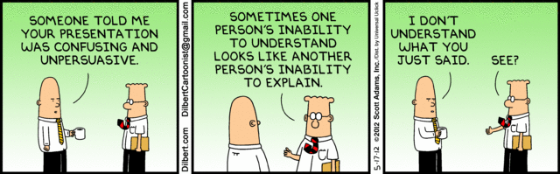
Have you ever given a presentation and felt like this?

What about this don’t you understand?

Comments Off on Explanation and Understanding . Permalink . Trackback URL
WordPress Tags: ,
 

Titantic Catastrophe: Compliant Doesn’t Mean Secure

Information Security
Author: Mark Dixon
Friday, April 27, 2012
9:33 am

TitanicApril 15th marked the 100th anniverasary of the sinking of the RMS Titanic – by any measure a catastrophe of epic proportions. As we think about lessons collectively learned from this event, may I suggest a nugget worth remembering that has little to do with sinking ships, but a lot to do with the enterprise we serve today?

According to a recent ABC article:

… the Titanic was fully compliant with all marine laws. The British Board of Trade required all vessels above 10,000 tonnes to carry sixteen lifeboats. The White Star Line ensured that the Titanic exceeded the requirements by four boats.

But we all know that twenty lifeboats were not nearly enough for this ship.  The article continues:

But the ship was 46,328 tonnes. The Board of Trade hadn’t updated its regulations for nearly 20 years. … The lifeboat regulations were written for a different era and enforced unthinkingly.

“Enforced unthinkingly.”  Therein lies our little lesson.

In discipline of information security, we may be tempted to think that “compliant” means secure.  But we must not accept that at face value.  We must really understand what regulations mean and how they apply to our enterprises.  PCI DSS or HIPAA compliance may go part way, but do they really go far enough to protect our vital information that is the lifeblood of our businesses?

Let’s make sure we have adequate “lifeboats” and not rely completely on those who write regulations to protect our businesses.


Comments Off on Titantic Catastrophe: Compliant Doesn’t Mean Secure . Permalink . Trackback URL
 

The Linked Data Strategy for Global Identity

Identity
Author: Mark Dixon
Thursday, March 15, 2012
11:38 am

Links

A colleague recently shared an interesting article with me.  “The Linked Data Strategy for Global Identity” by Hugh Glaser and Harry Halpin focuses on dealing with “the Identity problem in the context of linked data.”  Unfortunately, there is a charge to by the article, but here is an overview.

The topic is introduced this way:

Identity is easily one of the most difficult research areas on the Web and Semantic Web, and one that needs both practical solutions and multidisciplinary research. Identity is how to refer reliably to anything, abstract or more concrete, over time and space, and in different contexts. We’re used to identity being quite simple, as your name easily refers to you when another person is speaking to you. Yet on closer inspection, and at a Web scale, identity is quite tricky, as when you type your name into a search engine and see that it can refer to many other people in different contexts.

I can identify with that problem – there are many “Mark Dixons” in the world who are far more famous than I.  For example, I am quite sure that “Emmy-nominated and AP Award winning Channel 3 Early Warning Weather Meteorologist Mark Dixon” is not the author of this blog.

The whole topic of Linked Data is fascinating to me.  A Wikipedia article on the subject states:

Linked data describes a method of publishing structured data so that it can be interlinked and become more useful. It builds upon standard Web technologies such as HTTP and URIs, but rather than using them to serve web pages for human readers, it extends them to share information in a way that can be read automatically by computers. This enables data from different sources to be connected and queried.

Again, I can relate … there exists a myriad of data about me on the Internet, some published by me and some by others.  It is really very disjoint and often unconnected.  If people poke around at the information, they may be able to related disparate items because they recognize my photo or other descriptive attributes.  However, it would be very difficult for computers to automatically related all the different items. (That might now be such a bad think in many cases).

After exploring a few alternative approaches to this thorny problem, the Global Identity article concludes:

The entire bet of the linked data enterprise critically rests on using URIs to create identities for everything. Whether this succeeds might very well determine whether information integration will be trapped in centralized proprietary databases or integrated globally in a decentralized manner with open standards. Given the tremendous amount of data being created and the Web’s ubiquitous nature, URIs and equivalence links might be the best chance we have of solving the identity problem, transforming a profoundly difficult philosophical issue into a concrete engineering project.

It will be interesting to see what progress is made on this issue in upcoming years.


Comments Off on The Linked Data Strategy for Global Identity . Permalink . Trackback URL
WordPress Tags: ,
 

Resurrecting Discovering Identity on Blogs.Oracle.Com

Identity
Author: Mark Dixon
Thursday, March 15, 2012
10:41 am

In response to requests that I refresh my Discovering Identity blog that has been lying dormant on blogs.oracle.com since February 2010, I have commenced today to satisfy that request.

Discovering Identity

I created this blog on blogs.sun.com in May 2005 and updated it regularly until Oracle acquired Sun in February 2010, at which time I switched to self-publishing the blog here at discoveringidentity.com.  The full archive of my posts from May 2005 to February 2010 is available on this site and also on the oracle.blogs.com site.  From now on, I will publish items of interest to the Oracle community on both sites and address issues beyond that scope on this discoveringidentity.com site.

If anyone has items you would like me to address specifically on the blogs.oracle.com site, please let me know.

Comments Off on Resurrecting Discovering Identity on Blogs.Oracle.Com . Permalink . Trackback URL
WordPress Tags: , ,
 
Copyright © 2005-2016, Mark G. Dixon. All Rights Reserved.
Powered by WordPress.