[Log In] []

Exploring the science and magic of Identity and Access Management
Saturday, December 20, 2025

KuppingerCole on Oracle Audit Vault and Database Filewall

Information Security
Author: Mark Dixon
Tuesday, March 12, 2013
3:11 pm

Kuppingercole

KuppingerCole just released a Snapshot report on Oracle Audit Vault and Database Firewall.  It provides a good overview of this product, which recently merged into one combined product, encompassing the functionality previously in two products.  Can you guess their names?  Yep – Oracle Audit Vault and Oracle Database Firewall.

With the new product, Oracle combines these offerings. Notably this is about integration, not just about a suite of two different products.

For example:

The new offering has a single administrator console and fully integrates the two products.  Events generated by the database firewall component are automatically provided to the audit vault component.

Primary features include:

  1. Database firewall: detecting and blocking database attacks, including SQL injection attacks, the most common web application threat.
  2. Database and “stack” auditing: auditing across the stack, including operating system events, file system events (Oracle ACFS), the databases themselves, and custom audit logs.
  3. Separation of duties: segregation between administrators and auditors to avoid fraud on collected audit data; supported by a fine-grain security model.
  4. Alerting: flexible configuration of complex alerting conditions, including multi-event alerts with thresholds and group-by.
  5. Flexible deployment models: support for a wide range of deployment models, from out-of-band monitoring to full in-line high availability mode.
  6. Single administration console: unified administration console to manage all features and policies through a single interface.
  7. Compliance reporting: dozens of out of the box reports that can be easily customized through the user interface.

The databases currently supported are Oracle Database, MySQL, SAP Sybase, IBM DB2, and Microsoft SQL Server


Comments Off on KuppingerCole on Oracle Audit Vault and Database Filewall . Permalink . Trackback URL
WordPress Tags:
 

Mandiant Report: APT1 – Exposing One of China’s Cyber Espionage Units

Information Security
Author: Mark Dixon
Monday, March 11, 2013
12:39 pm

Mandiant

Mandiant, an American cyber security firm, recently released a 74 page report documenting evidence of cyber attacks by the People’s Liberation Army of the Republic of China:

Since 2004, Mandiant has investigated computer security breaches at hundreds of organizations around the world. The majority of these security breaches are attributed to advanced threat actors referred to as the “Advanced Persistent Threat” (APT). … this report is focused on the most prolific of these groups. We refer to this group as “APT1” and it is one of more than 20 APT groups with origins in China. APT1 is a single organization of operators that has conducted a cyber espionage campaign against a broad range of victims since at least 2006. From our observations, it is one of the most prolific cyber espionage groups in terms of the sheer quantity of information stolen. …

APt1 has systematically stolen hundreds of terabytes of data from at least 141 organizations, and has demonstrated the capability and intent to steal from dozens of organizations simultaneously. APT1 has a well-defined attack methodology, honed over years and designed to steal large volumes of valuable intellectual property. Once APT1 has established access, they periodically revisit the victim’s network over several months or years and steal broad categories of intellectual property, including technology blueprints, proprietary manufacturing processes, test results, business plans, pricing documents, partnership agreements, and emails and contact lists from victim organizations’ leadership.

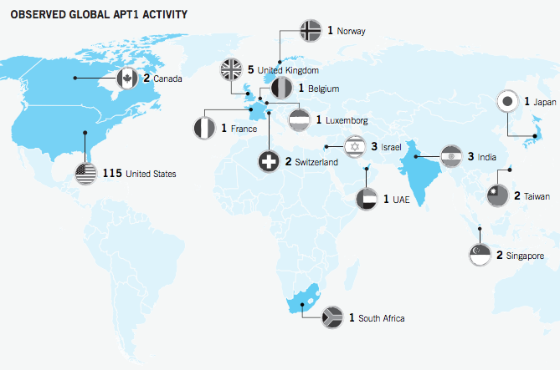
This detailed report includes a map showing observed APT1 activity …

Mandiant3


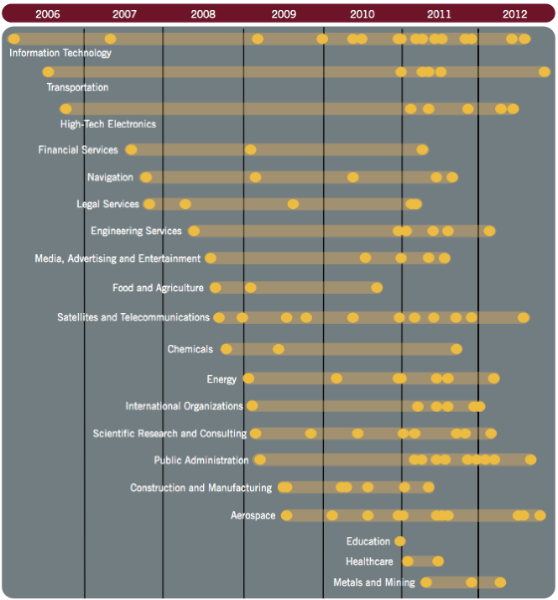
… and a timeline of observed compromises by industry sector:

Mandiant2


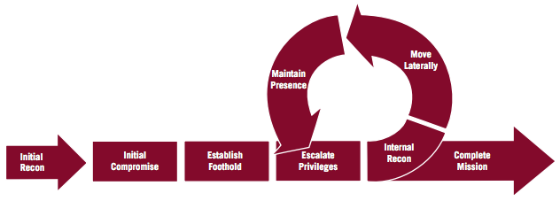
The report includes a detailed analysis of the APT attack lifecycle and methods for compromising the systems in the targets they attacked:

Mandiant1

Detailed background about  the infrastructure used in the attacks and some of the people involved in this work are also included.

The report concludes:

In a State that rigorously monitors Internet use, it is highly unlikely that the Chinese Government is unaware of an attack group that operates from the Pudong New Area of Shanghai. The detection and awareness of APT1 is made even more probable by the sheer scale and sustainment of attacks that we have observed and documented in this report. Therefore the most probable conclusion is that APT1 is able to wage such a long-running and extensive cyber espionage campaign because it is acting with the full knowledge and cooperation of the government. Given the mission, resourcing, and location of PLA Unit 61398, we conclude that PLA Unit 61398 is APT1.

Perhaps this statement from Sun Tzu, in his book, The Art of War, is particularly appropriate in this case:

If you know the enemy and know yourself, you need not fear the result of a hundred battles. If you know yourself but not the enemy, for every victory gained you will also suffer a defeat. If you know neither the enemy nor yourself, you will succumb in every battle.

Comments Off on Mandiant Report: APT1 – Exposing One of China’s Cyber Espionage Units . Permalink . Trackback URL
 

Tree Down!

General
Author: Mark Dixon
Saturday, March 9, 2013
9:16 am

Yesterday’s storm toppled a big eucalyptus tree across the backyard fence.

Treedown

Can you guess what we get to do today?

Comments Off on Tree Down! . Permalink . Trackback URL
WordPress Tags:
 

IFTTT – did it work?

Blogging, Social Media
Author: Mark Dixon
Saturday, March 9, 2013
8:15 am

IFTTT

Last night, I was experimenting with IFTTT to see if it would automatically announce my blog posts on Twitter and LinkedIn.  Last night, it worked on LinkedIn, but not Twitter.  Apparently there was a problem with authentication to my Twitter account. That fixed, it seemed to work just fine this morning … albeit not very quickly.

Comments Off on IFTTT – did it work? . Permalink . Trackback URL
WordPress Tags:
 

Hunting Zebras with Security Analytics

Information Security
Author: Mark Dixon
Saturday, March 9, 2013
8:07 am

Zebraandhorses

Much has been written and said recently about using data analytics to mine data for existing or probable security breaches. This morning, thanks to a tweet by @RohanPinto, I learned about a small, but practical application of this science … hunting Zebras.

In a Dark Reading article entitled, “Five Ways To Better Hunt The Zebras In Your Network,” Robert Lemos talked about zebras:

… Not the kind on that roam the African savannah, but the kind that sit at computers behind the corporate firewall.

Zebras are the employees, and their computers, who are doing something odd. Defenders are right to want to protect the zebras in their network, but defenders should occasionally “radio tag” and follow their zebras to see where they go.

He then proposed five steps to fight the zebras who might do you harm

  1. Know the network
  2. Collect all the data
  3. Find the foolish zebras
  4. Combine with threat intelligence
  5. Check back on your foolish zebras

It is worth the time to read the details of each step.

Happy Hunting!

Comments Off on Hunting Zebras with Security Analytics . Permalink . Trackback URL
WordPress Tags:
 

First Tweet

Social Media
Author: Mark Dixon
Saturday, March 9, 2013
7:43 am

This morning, I stumbled across a feature of Twitter that allowed me to download an archive of my tweets – all 11,651 of them, dating back to May 2007 when I first got on this crazy ride.  Here is my first, ever so profound tweet …

Firsttweet

… and a graphic navigator showing the relative number of tweets I posted each each month.

Twitterhistory

Comments Off on First Tweet . Permalink . Trackback URL
WordPress Tags:
 

IFTTT – will it work?

Blogging
Author: Mark Dixon
Friday, March 8, 2013
11:07 pm

I am testing a new recipe on IFTTT.com.  If an announcement of this post automatically appears on Twitter, it works.

IFTTT


If it works, it will save me a few keystrokes each time I blog, but perhaps more importantly, will demonstrate a simple form of cloud based programming.

Comments Off on IFTTT – will it work? . Permalink . Trackback URL
WordPress Tags:
 

Identity and Access Management – Capability Model

Identity
Author: Mark Dixon
Friday, March 8, 2013
3:57 pm

In a recent twitter conversation with Andre Koot, he suggested that we needed innovation in both Identity Management and Access Management.  He referred me to his blog, entitled “Let’s Kill the IAM Acroynm.”  Andre suggested:

Identity Management is a process for managing the lifecycle of identities … Access Control is a whole different ballgame …

After reading his blog, it occurred to me that he and I defined those two terms a bit differently.  I promised Andre that I would blog about it.

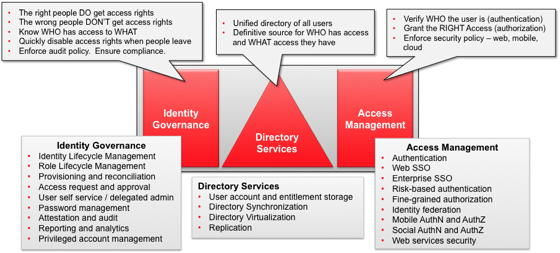
The diagram below shows how we at Oracle talk about the broad area of Identity and Access Management – encompassing three general areas:

  1. Identity Governance is about making sure the right people are granted the right access rights and making sure the wrong ones aren’t
  2. Access Management is about enforcing those access rights, within specified policy, when users attempt to access a desire application or system
  3. Directory Services provides ways to control where identity information about users and accessed rights are stored.
Oracle IAM

Does this provide the right demarcation between the various functional areas?  It seems to resonate well with our customers, and provides a valuable model to aid communications.  I’d be happy to hear any feedback you have.

By the way, this diagram is more effective as a PowerPoint build slide.  Let me know and I’d be happy to send you a copy.


Abundance vs. Scarcity – Which do You Choose?

General
Author: Mark Dixon
Thursday, March 7, 2013
7:41 am

Sunrise

On the whiteboard in my office is a statement, “Abundance is born of shared ideas,” which I wrote down when first introduced to the book, “The Emergence of the Relationship Economy.”  We don’t have to look very far to find many examples of how innovation sprang from ideas shared among creative, energetic people, leading to a rich abundance and growth of health, happiness or monetary wealth.  This type of expansive thinking and action results when people look outside their situation in life, whatever it may be, and concentrate on what can be, rather than what is.  This is an Abundance Mentality.

In contrast, a Scarcity Mentality prompts people to look inwardly, concentrating on the supposed constraints of a situation or condition in life.  Perhaps this is no better illustrated that in a video being shared widely on Facebook. “9 Out Of 10 Americans Are Completely Wrong About This Mind-Blowing Fact.”

This video cleverly compares the wealth of the 1% richest people in the US with the rest of us 99 percenters. The graphics are well done, the narration and music are professional.  However, there are at least five glaring errors in the supporting logic:

  1. By focusing on relative percentages rather than absolute values of personal wealth, the video infers that somehow the wealth of the 1% automatically diminishes the wealth of everyone else.  After all, the stack of money for a guy on the left side of the chart sure looks smaller than the stack on the right side.
     
  2. The video assumes scarcity, rather than abundance – that the sum of all society wealth or individual wealth is constrained to a fixed amount, that individuals are somehow limited in opportunity for growth because the 1% are insanely wealthy.
     
  3. The video assumes that “fairness” is defined by a more even distribution of wealth.
     
  4. The video infers that if some magic would occur to take the wealth of the 1% and spread it in some more equitable fashion across the rest of us, that we would all be more happy and the world would be a better place.
     
  5. The video assumes that monetary wealth is the ultimate measure of success or happiness.  After all, how can I be happy when someone else has more money than I do?
     
With these comments, I don’t intend to excuse that rampant greed that fuels so much of society today, but I propose that getting all caught up in the “Scarcity Mentality” embodied in this video diminishes our ability to focus on innovative thought and action, which could alternatively lead to abundant growth, both individually and as a society.
 
An example from my past is particularly important to me.  I grew up on a small farm in southern Idaho.  My college educated father loved farming, but couldn’t make enough money on the farm to support his growing family, so he began teaching school, an occupation he despised.  We still worked on the farm, plowing ground, harvesting crops, feeding pigs and milking cows – tasks that demanded relentless attention but yielded little monetary gain.  We never went on an overnight vacation; the cows demanded to be milked every morning and every night.
 
But my dad had a vision of what his children could become.  Knowing that he couldn’t afford to send us to college, he allowed us to work outside the farm to earn money to finance our education.  I bucked a lot of hay, milked a lot of cows and made a lot of cheese for other employers.  Dad could have focused on the scarcity  and constraints of our farm and demanded that I exert all my work on the farm within those constraints, but he favored the abundant focus, which enabled me to get an education and pursue a successful career.  Dad never achieved even a modicum of monetary success that would show up in the video, but measures his abundance in the success, happiness and abundant lives of his seven children and their families.
 
I recently watched a video where Ben Carson told of how his mother, one of 24 children, abandoned by a bigamist husband, living in dire poverty, refused to focus on her own bad situation, but make her sons study at the public library so they could rise above the dire conditions in which they were born. Inspired by what he read, Ben rose to become Director of Pediatric Neurosurgery at Johns Hopkins Hospital.  In addition to financial success, he has blessed many lives through his skill and dedicated service.
 
In my current employment, I could get all caught up in the fact that Larry Ellison has many more billions of dollars in his bank accounts than I have in mine, or that he has yet to invite me for dinner on his private Hawaiian island, or that I will never catch up to him monetarily.  That would be Scarcity Mentality on my part.  But when I focus on what I can do innovate, to serve our customers or to move our industry forward, opportunities blossom. That is the Abundance Mentality.


Tweet Chat: #mobileidm

Identity
Author: Mark Dixon
Wednesday, March 6, 2013
3:08 pm

Twitter iconPlease join me and other interested identerati on a live Tweet Chat  about Mobile Identity Management trends and security challenges.

Amit Jasuja, Senior Vice President, Development - Identity Management and Security Products, will host the chat via @OracleIDM.

When?  Tomorrow, March 7th, at 9:00am PST

Please use hashtag #mobileidm in your tweets.

Our last Tweet Chat  (or was it Tweet Jam?) was a great success.  Let’s make this one even better.

Comments Off on Tweet Chat: #mobileidm . Permalink . Trackback URL
WordPress Tags: ,
 
Copyright © 2005-2016, Mark G. Dixon. All Rights Reserved.
Powered by WordPress.