Data Breaches and Data Werewolves

Finally, a solution to big data breaches …
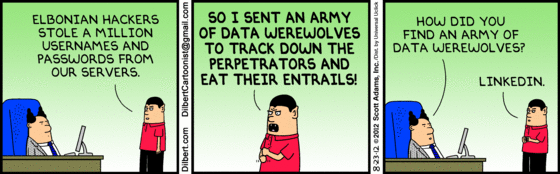

Finally, a solution to big data breaches …
I recently signed up to receive an “Image of the Day” from NASA. How fitting that a rare second Full Moon of the month, known as a “Blue Moon,” could be seen over Cincinnati on Friday, Aug. 31, 2012.
The family of Apollo 11 Astronaut Neil Armstrong held a memorial service celebrating his life earlier in the day in Cincinnati. Armstrong, the first man to walk on the moon during the 1969 Apollo 11 mission, died Saturday, Aug. 25. He was 82.

 Meme: “an idea, behavior or style that spreads from person to person within a culture.”
The Wikipedia article on Meme further states:
A meme acts as a unit for carrying cultural ideas, symbols or practices, which can be transmitted from one mind to another through writing, speech, gestures, rituals or other imitable phenomena. Supporters of the concept regard memes as cultural analogues to genes in that they self-replicate, mutate and respond to selective pressures.
The book I recently finished, “The Information,” devoted an entire chapter to the meme concept, with an intriguing title, “Into the Meme Pool (You Parasitize My Brain)”. The chapter starts by quoting Douglas Hostader:
When I muse about memes, I often find myself picturing an ephemeral flickering pattern of sparks leaping from brain to brain, screaming, “Me, me!”
Jacques Monod, the Parisian biologist who shared the Nobel Prize for working out the role of messenger RNA in the transfer of genetic information opined that memes were somehow independent of the organisms (we humans) who create, distribute and alter ideas:
Ideas have retained some of the properties of organisms. Like them, they tend to perpetuate their structure and to breed; they too can fuse, recombine, segregate their content; indeed they too can evolve, and in this evolution selection must surely plan an important role.
I can’t quite buy into the philosophy of memes being the controlling entities looking for willing hosts in which to perpetuate, morph and re-launch themselves, but there is no doubt that memes can quickly emerge, travel and transform rapidly into new memes that capture the popular consciousness. The empty chair meme, launched by Clint Eastwood at last week’s Republican National Convention (or was it the other way around), has taken flight around the world in many forms in a few short days.
I didn’t put an empty chair in my front yard or otherwise take part in today’s “#EmptyChairDay,” but find it intriguing how quickly this meme has spread. Just take a look at Google images for “empty chair“:

So, if you have some time, pull up an empty chair and have a chat with the President. And of, course, publish a photo of your conversation on Facebook!
Remember the Mercury Comet from way back in the day?

I hadn’t thought of that car in ages, until I rode home in a taxi last Thursday evening. The taxi driver had this sign in the window:

The taxi wasn’t a Comet, but the phrase “Don’t Vomit in My Comet” jumped into my mind and wouldn’t leave. I guess that shows you what odd thoughts I have from time to time.
More odd thoughts … I just learned on Wikipedia that a reduced gravity aircraft, a type of fixed-wing aircraft that provides brief near-weightless environments in which to train astronauts, conduct research and film motion pictures, has been called a “Vomit Comet” by people who have experienced it.
There you have it for tonight!
Great quote from an article about Apple’s near $700 stock price:
Will the iPhone in 50 years look like so many tail fins on those old Cadillacs?
It is hard to imagine what the next 50 years will bring in technology innovation, but I think it is a safe bet that the the iPhones of 2012 will seem like quaint relics of the ancient past when viewed from that distant vantage point.
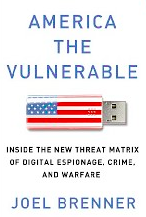 I am beginning to read a compelling book, “America the Vulnerable: Inside the New Threat Matrix of Digital Espionage, Crime, and Warfare,” by Joel Brenner, former senior counsel at the National Security Agency.
My favorite line in the introduction:
Our world is becoming a collection of glass houses that provide only the illusion of shelter.
More to come soon.
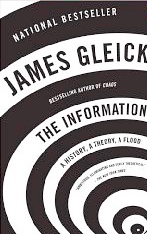 I just finished reading a fascinating book, The Information: A History, a Theory, a Flood, by James Gleick. My two favorite statements in the book occur in the first chapter and the last:
The first statement is attributed to Claude Shannon, who is generally recognized as the father of information theory. He wrote a letter to a colleague in 1939, which included this explanation:
I have been working on an analysis of some of the fundamental properties of general systems for the transmission of intelligence.” (emphasis added)
Although “information” has been accepted over “intelligence” as the commonly-used term in this area of science, the concept of transmitting and receiving intelligence has long fascinated me – from a scientific perspective because of my chosen profession and from a theological perspective related to the revelation of intelligence from God to man.
The second statement comes from Gleick himself in the final chapter, as he opined ever so succinctly on our life in an information-overloaded society:
The truth seems harder to find amid the multitude of plausible fictions.
I highly recommend the book. It is, as a USA Today writer stated, “Like the best college courses: challenging by rewarding.”
 The Register reported today:
Hacker collective Team GhostShell leaked a cache of more than one million user account records from 100 websites over the weekend.
The group, which is affiliated with hacktivists Anonymous, claimed they broke into databases maintained by banks, US government agencies and consultancy firms to leak passwords and documents. Some of the pinched data includes credit histories from banks among other files, many of which were lifted from content management systems. Some of the breached databases each contained more than 30,000 records.
The bad guys aren’t done yet:
“All aboard the Smoke & Flames Train, Last stop, Hell,” Team GhostShell wrote. “Two more projects are still scheduled for this fall and winter. It’s only the beginning.”
I repeat the final question of my last post, “If this data is so important to enterprises, what are they doing to really secure it?â€
 Capgemini recently released a report, “The Deciding Factor: Big Data & Decision making,†which states that:
“nine out of ten business leaders believe data is now the fourth factor of production, as fundamental to business as land, labor and capital.”
Furthermore,
“Two-thirds of executives consider their organizations are ‘data-driven’, reporting that data collection and analysis underpins their firm’s business strategy and day-to-day decision-making.”
According to Gartner Inc.,
“Business executives and IT managers are increasingly referring to information as one of their organization’s most critical and strategic corporate assets. Certainly there is a sharp rise in enterprises leveraging information as a performance fuel, competitive weaponry and a relationship adhesive.â€
This all begs the question, “If this data is so important to enterprises, what are they doing to really secure it?”
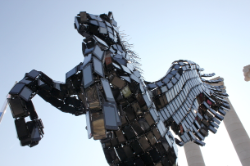 CNET reported today on a congressional committee wants to know whether Huawei, a telecommunications powerhouse is a national security threat.
Huawei is much larger than I realized:
Huawei is the second largest telecommunications equipment maker in the world, behind only Sweden’s Ericsson. It generated $32 billion in revenue last year, selling its networking technology to such global giants as Vodafone, Bell Canada and Telekom Malaysia, though only smaller U.S. carriers Leap and Clearwire use the company’s gear. Huawei’s heft has allowed it to pour resources into adjacent markets, such as mobile handset development and data center technology that’s already paying off with new customers and billions more in revenue. …
And Huawei is a patent machine, with about 50,000 patents filed worldwide. Though accused years ago of pilfering the innovations of Cisco and others, Huawei gets credit these days for breakthroughs in complex technologies such as radio access networking that lets mobile carriers support multiple communications standards on a single network. It also pioneered the dongles that consumers slip into laptops to wirelessly connect to the Web.
Because of their size, power and national origin, some are very worried:
The broader concern, though, is of a dangerous marriage of Huawei’s capability — it wants to build a massive swath of the telecommunications network, from routers and switches to the phones consumers use — with the Chinese government’s motive and intent. A report last year from the Office of the National Counterintelligence Executive found that the Chinese are the “world’s most active and persistent perpetrators of economic espionage.” The committee wants to thwart the possibility Chinese cyberattacks in the United States over Huawei’s technology before the company, which has only a modest U.S. presence, grows into a powerhouse here. …
Hawks in the federal government remain unconvinced that his company is merely a financial success story. They worry that Huawei, whose technology provides infrastructure to communications networks, is a tool of the Chinese government, potentially enabling it to snoop on critical corporate and government data through digital backdoors that Huawei has the ability to install.
I don’t know the answers here, but this is certainly food for thought.