[Log In] []

Exploring the science and magic of Identity and Access Management
Saturday, December 20, 2025

IoT – Emerging and Receding Invisibly into the Fabric of Life


Identity, Internet of Things
Author: Mark Dixon
Monday, April 1, 2013
9:08 pm

Iot1

Last week, T.Rob Wyatt authored an intriguing post, “Futurist’s Groundhog Day.” I found it by following Phil Windley‘s tweeted recommendation:

Futurist’s Groundhog Day: http://t.co/pq75vMPZsS #vrm

It wasn’t long before Doc Searls tweeted,

The best #VRM post, ever: http://t.co/IiQrMR12Ox, by @tdotrob, honored here: http://t.co/xERNWkA6Sp

I agree that the post addressed the VRM concept very well, but I particularly liked T.Rob’s description about how technology, once broadly accepted, “disappeared into the fabric of life.”

First, a historical observation:

The first electric motors were envisioned to replace steam motors within the same architecture: one big motor, lots of belts and pulleys. But what actually happened was that electric motors disappeared into the fabric of life. There’s one on my wrist as I write this. There are roughly 30 within arm’s reach of my chair. Electric motors are invisible. We don’t think of them as motors, we think of them as a watch, hard drive, CD/DVD player, printer, sprinkler valve, drill, toy, fan, vacuum cleaner, etc.

Next, a prediction:

In the near future a “smart switch” will just be a switch. A “smart” anything will just become that thing and the old version will become a “dumb thing.” The instrumentation will no longer be a novelty but will recede invisibly into the fabric of life. When steam engines were replaced by electric motors, it was hard to imagine a time when motors would fit on your wrist. It’s just as difficult today to imagine why we’d want sensors and actuators in all our devices and objects but let’s table that and stipulate that it happens.

And further observation about when sensors become ubiquitous:

In the very near future your casual behavior and activities will be trackable with the precision and detail only possible today in the confines of a lab. Every device, object or surface will potentially be a sensor. The physical constraints assumed by the current legal framework and that balanced the power of individuals against corporate and government interest are disappearing. The digital representation of you that was once a rough tile mosaic is coming into focus for vendors and government as a hi-def, crystal image.

In my lifetime, it has been great to see so much technology emerge as novelty and then become commonplace. Think pocket calculators, microwave ovens and mobile phones.  Now, the Internet of Things, including ubiquitous sensors, is emerging.  We can expect IoT to grow, become commonplace and then “recede invisibly into the fabric of life.”

Hence, T.Rob’s challenge:

IoT is coming so embrace it.  It is inevitable and it is closer than you think.  If you start with 50 billion instrumented things (or trillions if you are ambitious) and work backward, what do we need to build to pave the road between here and there?

Exciting stuff.  Just think – every one of those billions of devices will have an identity (or identifier, depending on your point of view).  Sign me up for the journey.

Comments Off on IoT – Emerging and Receding Invisibly into the Fabric of Life . Permalink . Trackback URL
WordPress Tags: ,
 

LinkedIn Should Use Connect.me

Identity
Author: Mark Dixon
Saturday, March 30, 2013
6:11 am

Connectme225

Make no mistake.  I am honored when people choose to endorse me on LinkedIn.  I appreciate them taking a few moments to click the button and send a message my way that they think I have a certain positive capability.  I always try to respond in kind.

However, LinkedIn could certainly take lessons from Connect.me, or better still, use Connect.me, when it comes to vouching for and cataloging a person’s capabilities.  Here are some deficiencies in the LinkedIn approach that are much better implemented in Connect.me:

Whom have I endorsed?  On LinkedIn, I have no way to review the people I have endorsed or what capabilities I have endorsed.  I would really like to step through a list of my contacts, see which ones I have endorsed, and for what.

Who has endorsed me? On LinkedIn, there is no way I have found to review a list of my contacts and know if they have endorsed me or what they have endorsed me for.

Iconlinkedin

In your face, with limited information.  I resent that each time I access LinkedIn, I am presented with a grid of four people, each with one capability, asking for me to endorse them. There are two problems here.  First, I link to endorse people as a conscious action, not upon an impulse.  Second, I should like to consider multiple endorsements of a person, rather than just the one LinkedIn suggests.  This often results in a scattered sequence of individual endorsements, rather than a cohesive set of endorsements.

Ease of use.  When LinkedIn does suggest a person to endorse, I can’t easily go to his or her profile page to do a multiple endorsement set.  I must type in his or her name to reach the profile page.

Well, there my rant.  It’s doubtful that LinkedIn will listen to me … but hopefully they will fix their reputation system just the same.


Comments Off on LinkedIn Should Use Connect.me . Permalink . Trackback URL
 

Core Identity – Reprise

Identity
Author: Mark Dixon
Friday, March 29, 2013
9:13 pm

Today, I enjoyed reading T.Rob’s post, “ Do you consider your digital identity a separate self or is it identical to your real-world self?”  I started to respond to his post as a comment, but decided to write the following post.

Back in November, 2005, I began writing a series of posts about “The Identity Map,” which was centered on a concept I called “Core Identity.”

I think this Core Identity concept goes to the heart of what T.Rob discussed – that perhaps:

identities change over time … The one place we make an effort to distinguish between a person’s identities is in the present moment. The T.Rob who exists right now is a multi-faceted, yet unique entity. I participate in many communities across many interests …

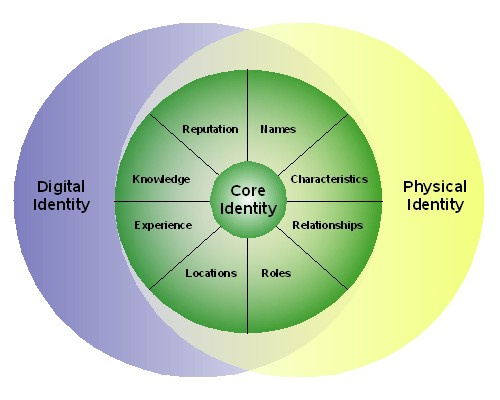
I would propose that the core of who we are does not change, but many characteristics, including both physical and mental attributes do change over time. We may possess multiple “digital identities,” or perhaps more specifically, “digital personas,” which are but subsets of the complex core identity and the myriad set of attributes surrounding that core.  I drew this chart in November, 2005:

Coreidentity

The remainder of this post comes from a couple of earlier posts - here and here.  Thanks, T.Rob, for triggering these memories.

—-

Core Identity is the essence of who a person is. This unique “Core Identity” can be identified or described by attributes that belong to and describe an individual. Some unique characteristics (e.g. DNA signature, footprint) are immediately measurable at birth. Others change over time.

The attributes that further identify and describe an individual are:

Names. I am known by many names. My given name is Mark. My surname is Dixon. My i-name is MarkDixon.My social security number is [wouldn’t you like to know?]. My kids call me Dad.

Characteristics. I have some measureable characteristics that don’t change – my DNA signature, my fingerprints. Others change over time – height, weight, hair color. Does IQ change? I don’t know.

Relationships. I have relationships with people, institutions and things. I am father to my children, brother to my siblings, husband to my wife. I am an employee of Sun Microsystems and an alumnus of Brigham Young University. I own a Nikon camera. I love Chinese food. I can’t stand professional wrestling.

Roles. The functions I perform in life are roles: Father, husband, Sun Identity Practice Lead, Identity blogger, Church volunteer, registered voter.

Location. When I used to travel every week, I’d tell people I claimed home addresses in Mesa, Arizona and United seat 2B. These are descriptors of physical locations, relative to different known reference points. However, my current location (latitude, longitude, elevation) will vary, dependingon where I am physically located at any moment in time.

Experience. I have experienced many things in the 52+ years of my earthly existence. I have been stabbed by a pitchfork, run for a touchdown, flown around the world and milked a cow (many times). Each experience adds uniqueness to my core identity.

Knowledge. During my existence, I have amassed much knowledge, some of it shared by many, some of it unique. Both you and I probably know the Pythagorean Theorem. You probably don’t know the names of my kids. I hope you don’t know my blog password.

Reputation. Other people and institutions say things about me, some of it good, some of it bad. The credit bureaus say I have a good credit rating. The DMV say I’m a so-so insurance risk because I’ve had a couple of tickets in the past three years – but they also say I hold a valid drivers license. BYU says I hold a BSEE degree. My wife likes me (and that is what really counts).


Privacy by Design – Principles or Requirements?

Information Security, Privacy
Author: Mark Dixon
Friday, March 29, 2013
7:58 pm

Pdb2

After reading the white paper, “Privacy and Security by Design, A Convergence of Paradigms,” this week, I pinged a couple of associates on Twitter to see what they thought about Privacy by Design.  Steve Wilson replied to the effect that “We need more than principles.  We need implementable requirements.”

When I met with  Ann Cavoukian yesterday, I asked her about that viewpoint.  She agreed that we need to step beyond principles to requirements to implementation.  She gave me a copy of a paper published last December by the PdB team, entitled, “ Operationalizing Privacy by Design: A Guide to Implementing Strong Privacy Practices.”  This paper doesn’t provide all the answers, but begins to explore how privacy is being implemented in 9 application area:

  1. CCTV/Surveillance Cameras in Mass Transit Systems
  2. Biometrics Used in Casinos and Gaming Facilities
  3. Smart Meters and the Smart Grid
  4. Mobile Devices & Communications
  5. Near Field Communications (NFC)
  6. RFIDs and Sensor Technologies
  7. Redesigning IP Geolocation Data
  8. Remote Home Health Care
  9. Big Data and Data Analytics

Interestingly enough, when Marc Chanliau shared with me a his unpublished report from which came the security content for the “Privacy and Security by Design” paper, it was gratifying to see the title he had selected for that larger report: “Requirements for Enterprise Security.”

There is much to do, but progress is being made.

Comments Off on Privacy by Design – Principles or Requirements? . Permalink . Trackback URL
WordPress Tags: ,
 

Ah, the Mystery of Email!

Humor
Author: Mark Dixon
Friday, March 29, 2013
4:43 pm

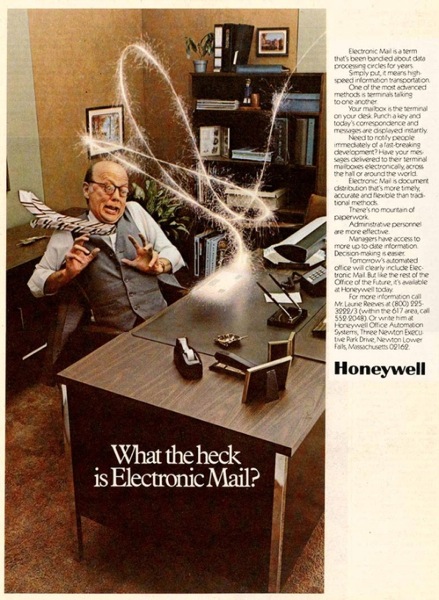
Do you remember when email was mysterious, even odd?  Quite a thought while we wade through our jam packed email inboxes every day.

Thanks to i09’s “Hilarious and Awesome Computer Ads from the Golden Age of PCs.

Honeywell

Comments Off on Ah, the Mystery of Email! . Permalink . Trackback URL
WordPress Tags: ,
 

Strong Alignment: Privacy and Security by Design

Information Security, Privacy
Author: Mark Dixon
Thursday, March 28, 2013
2:52 pm

Today I had the privilege of having lunch with Dr. Ann Cavoukian, Information and Privacy Commissioner of Ontario, Canada, along with Jack Crail, Oracle Director of Security Sales Consulting for the Western US.  It was a pleasure to have a delightful lunch, sitting outside in the deliciously warm springtime air in Scottsdale, AZ.  We explored many topics of mutual interest, but focused primarily on the concepts in the white paper, “Privacy and Security by Design, A Convergence of Paradigms,” published recently by Dr. Cavoukian and Marc Chanliau, Director, Product Management with Oracle.

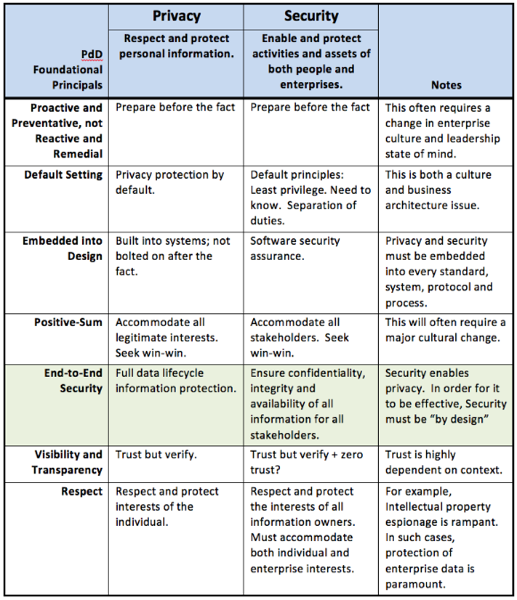
I had prepared the following matrix which shows remarkably close alignment with the seven foundational principles of Privacy by Design and how these principles could also apply to Information Security.  We recognize that the scope of security is broader than privacy, but the needs to proactively build security into all the technology and processes we create are remarkably similar.

Bydesign2

In this matrix, row 5 (End-to-end security) shows where security and privacy interact.  In fact, end-to-end security is a necessary enabler for privacy.  The other rows begin to explore how a Security by Design approach can align with and support Privacy by Design.

While this matrix is just in draft form, I believe it can help us discuss how  the goals and solutions of privacy and security can be aligned in a meaningful way.  

If any on you would like to offer any suggestions for improvements, please let me know.

Comments Off on Strong Alignment: Privacy and Security by Design . Permalink . Trackback URL
WordPress Tags: ,
 

Expanding the #SquareTag Experiment

Identity
Author: Mark Dixon
Wednesday, March 27, 2013
11:04 pm

Qr sqtgmevdvh 150

Ok … just for grins, I expanded the SquareTag Experiment to include two more online things:

The new orange SquareTag QR codes are courtesy of  QRPhoria.

By the way, I got two new messages today – from Australian and Canada.  Thanks!

Comments Off on Expanding the #SquareTag Experiment . Permalink . Trackback URL
WordPress Tags:
 

Report on my #SquareTag experiment

Identity
Author: Mark Dixon
Wednesday, March 27, 2013
4:06 pm

A quick report on my little Squaretag4SquareTag blogtagging experiment …

Thanks to all who participated.  I received about 20 responses, from eight states, plus the District of Columbia and Scotland.  I was able to connect with most of the people who responded.  However, since the SquareTag web app wasn’t optimized for collecting contact information, I still don’t know where some respondents were located.  I enjoyed getting geotag information on several responses, but I didn’t receive geotag information on others, presumably since the respondent didn’t approve of sending the location information.

A few other points were interesting:

The attention span of social media users is short.  There were a few respondents each day I announced the experiment on Twitter, but then the response rate quickly fell to zero.

Even though the invitation still remains in the header of my blog, I haven’t received any responses for several days.  That probably means two things: 

  • Very few people visit my blog
  • Those who do visit aren’t  very interested in an arcane blog tag experiment.

That’s ok.  I am used to living in the long tail.

I want to thank  Phil Windley and a couple of people from his team who helped me. They were very supportive, and I got to understand their intriguing technology platform a bit more.  I will send a few suggestions their way, and hope to stay in close touch as the technology matures.

I plan to keep the SquareTag in the blog header for awhile, to see if someone, on the odd chance, is still interested.  So, if you are so inclined, feel free to scan or click the SquareTag.


Beautiful Holly

Family
Author: Mark Dixon
Wednesday, March 27, 2013
2:29 pm

Holly

Today, may I introduce you to our youngest daughter, Holly, who is serving a  mission for  The Church of Jesus Christ of Latter-day Saints in England, the country where I served my mission 40 years ago.  This week, we received a nice collection of photos taken since she arrived in mid February.  This is my favorite.

Godspeed, my beautiful daughter!

Comments Off on Beautiful Holly . Permalink . Trackback URL
WordPress Tags: , ,
 

Tyranny of Things? #IoT

Identity, Internet of Things
Author: Mark Dixon
Tuesday, March 26, 2013
7:57 pm

Iot

I really enjoyed the post  Rohan Pinto tweeted about this morning – Scott Morrison’s “ We can’t let the Internet of Things become the Tyranny of Things.” Scott stated:

My belief is that the Internet of Things (IoT) will succeed or fail based on its capacity for creating its own economy. But counting devices and multiplying by people isn’t quite the right math to satisfy this equation. The real key to IoT success is how open – and more significantly, how accessible – the technology is to independent innovators.

I liked Scott’s examples of bad IoT design …

seemingly every year some earnest manufacturer actually demonstrates yet another realization of this dubious vision, which usually consists of little more than a screen stuck onto the door like some giant fridge magnet. This is IoT designed by a committee …

When I purchased my last TV, I also bought the same manufacturer’s BluRay player in the hope I could get away with one remote and hiding the latter in a closed cabinet. Boy, was I naïve.

… but his good examples were also instructive:

Take a walk into the living room and you will find an excellent example of IoT meeting its potential. IoT done right is the netfNest. A brilliant team of ex-Apple employees found a completely moribund corner of everyday technology and transformed it. They created an irresistible object of desire that quietly adapted a ponderous machine of steel and natural gas into an Internet connected device. It’s brilliant. … 

IoT done right is twiNetflix, an innovator that came up with an open API that allowed all manner of devices to integrate using simple web-based protocols. Netflix could have easily screwed this one up. They might have decided to design arcane, binary protocols optimized to support minimalist devices. Instead, they opted for open and well-documented APIs that leverage existing web understanding. The effect was to make integration accessible instead of intimidating – and in doing so, Netflix tapped into a vast developer population. The result was a Cambrian explosion of applications and devices streaming the service. You would be hard pressed to find a modern TV, disk player, or media streamer that doesn’t now have a Netflix logo somewhere on the box.

Yep, I have a plethora of ways to connect to Netflix at my house. I haven’t yet invested in the four Next thermostats I would need to control the four AC zones in my house, but two of my sons have them.

In closing, Scott challenges us:

It’s time to worry less about trying to make the Internet of Things something different. Instead, we need to focus on making it more of the same, more like, well, the internet. Declare IoT open, base it on APIs, and then step back and watch the engine of Silicon Valley engage.

Well spoken, Scott. And thanks for introducing me to that eminently hashtaggable acronym: #IoT.

Comments Off on Tyranny of Things? #IoT . Permalink . Trackback URL
WordPress Tags: ,
 
Copyright © 2005-2016, Mark G. Dixon. All Rights Reserved.
Powered by WordPress.