Blogging with OpenOffice

I just upgraded to OpenOffice 2.4.1 and installed the Sun Weblog Publisher extension, which I used to post this little message.


I just upgraded to OpenOffice 2.4.1 and installed the Sun Weblog Publisher extension, which I used to post this little message.
I have spent the last couple of days with my Sun colleagues in Canada. Because of Sun’s position as supplier to the 2010 Winter Olympics in Vancouver, Sun Canada business cards and presentation templates are Olympics-themed. The back of each business card is shown below.
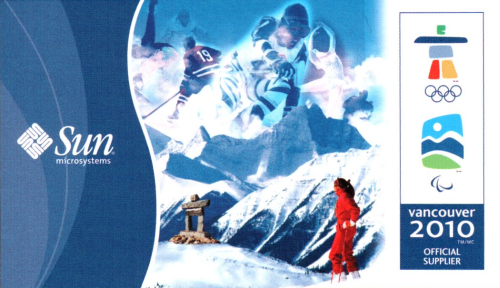
Go Canada!
Technorati Tags: Sun Microsystems, Olympics, Vancouver
 Last Friday was a bad battery day for me. My bluetooth headset battery died in the middle of a conference call. My mobile phone battery barely made it through that call before it died, too. My two laptop batteries didn’t provide enough juice to make it through my cross country flight from New York to Phoenix. To top it all off, when I got to the airport parking lot, my car battery was dead. Aaarrrrgh! (that is my contribution to Talk Like a Pirate Day).
In this hyper-connected electronic world we live in, we are terribly dependent on batteries. I did a quick inventory of the battery-powered devices I carry with me on my travels:
Plus my car, which apparently has a parasitic electrical leak we can’t find. Aaarrrrgh again!
I find it interesting and frustrating that in my lifetime, improvements in battery technology have been only incremental, not revolutionary. Our world is begging for some monumental breakthrough in energy storage technology that is cheap, efficient and long lasting.
In the mean time, I hope we can at least get some standardization in the devices and cables necessary to charge the batteries we have. Of the six devices I have that can be charged via a computer USB port, I must use six different cables. Aaarrrrgh again!
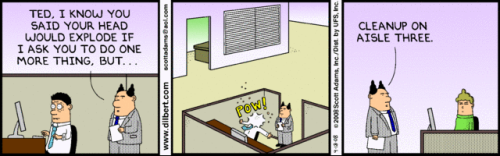
If sometime my brain explodes due to information overload from cyberspace (or from the pointy-haired boss), please send a cleaning crew to mop it up.
Technorati Tags: Dilbert, Information Overload
 It has been intriguing for me to read over the past several months about the accelerating demand for digital media distribution and download. In a crazy world where an YouTube video of yours truly going down a zip line Park City has been viewed over 2,750 times, it seems that online viewers have an insatiable appetite for content. Yet videos of zip lines are but a drop in the proverbial ocean of digital media. Just imagine when we really kick it in gear and demand that the industry provide both the ability to stream high defintion video to any device of our choice at any time we want, as well supporting our desire to generate and distribute high definition content ourselves.
This week, in an article entitled, “Deloitte Launches Initiative to Streamline Digital Media Distribution,” David Rips, lead architect of the Deloitte Digital Media Framework and director in Deloitte Consulting LLP’s Media and Entertainment practice, addressed the net effect of this appetite:
“… the technical scale and complexity required to deliver this demand far outstrips the capabilities and capacity of today’s digital media companies and infrastructure.”
The Deloitte Digital Media Framework proposes to establish a new digital media value chain that will enable the delivery of content from multiple creators, on multiple devices, through multiple carriers.
“The technology infrastructure needed to meet increasingly sophisticated media demands will dwarf anything we’ve seen before,”said Phil Asmundson, Deloitte LLP vice chairman and national managing partner of Technology, Media and Telecommunications.
It will be really interesting to see how this unfolds.
In the mean time, take another look at my zip line video. It had twice as many views today as it had the last time I checked. It will be interesting to see if the number doubles again.
Technorati Tags: Digital Media, Deloitte
 Washington Technology reported this week “BearingPoint to assist Marines with identity management“. I confirmed today that BearingPoint is using the Sun Identity Management suite as the basis for this significant project. Congratulations to our friends from BearingPoint on this significant win!
Technorati Tags: Sun Microsystems, Identity, Identity Management, Digital Identity, BearingPoint
Much has been said about user-centric, or user-controlled Identity allowing individuals to choose which subset of personal Identity attributes use in facilitating online interactions. Maybe this could be called “self personalization” because an individual is in control and actively choosing specific steps to follow.

But at the recent Digital Identity World conference, I had a minor epiphany. As a speaker addressed the subject of role management, it struck me that much of enterprise Identity management is also about personalization – granting people the specific rights and credentials to enable them to do their work. These assignments could be made automatically or with human intervention. This could well be termed “assigned personalization.”
I supposed that efforts like Amazon’s to deliver purchase recommendations based on past activities would be a form of “calculated personalization.”
In all three cases, the objective is similar – how can the online application experience be more closely aligned with who a person is and what the are doing at a particular time?
Personally (pun intended), I think this personalization stuff is fascinating. Those are happy thoughts.
Technorati Tags: Identity, Identity Management, Digital Identity
Last week, I posted a brief article about close family friends who are recovering from a serious plan crash.
The following news report, produced by a Phoenix television station, explores how bloggers from around the world are sending their hope and prayers to Stephanie and Christian.
Makes you kind of feel good about participating in the blogosphere!
 An excellent article on role management was published last week in CSO Online. Business drivers, benefits and challenges were listed from a Burton Group study:
“In its 2007 survey of 35 organizations, Burton Group found that the number of role management initiatives has grown significantly since 2003, especially in the financial services industry. The top business drivers include:
- Administrative efficiencies for access management
- Ease of audit and compliance
- Improved security controls for access and authorization
“The payoff? In return for your efforts, expect the following benefits:
- Simplified number of managed entities
- Improved visibility into available resources
- Better enforcement of policy
- Improved relationship of IT with the business
“The Burton Group says major challenges for these projects include:
- Establishing the relationship of roles to business and administrative processes
- Setting guidelines for defining and establishing roles
- Determining who should participate and in what capacity
- Determining how to maintain roles over time
- Associating roles with resources
- Determining how to associate business process and policy with roles”
A variety of customers, using several role management software tools, were quoted in the article in support of a good list of recommended Do’s and Don’ts for role mangement projects:
Although no vendors were directly quoted, many observations were favorable for the Sun Role Manager product.
I thought it interesting that Kevin Kampman, senior analyst at Burton, recommended the role discovery process directly supported by the Sun product:
“DO take a combined top-down, bottom-up approach. According to Kampman, role management typically combines a top-down (or business responsibility-driven) perspective, and a bottom-up (or system resource-oriented) approach. Top-down reflects the needs of the business, while bottom-up reflects the application privileges and permission sets to satisfy those business responsibilities.”
Craig Cooper, senior project manager at Thrivent Financial for Lutherans, a Vaau/Sun Role Manager customer, offered some interesting practical insights:
“Cooper sees role management as an integral part of enhancing Thrivent’s trusted reputation with customers. ‘We want to be able to demonstrate that we have the controls in place related to access, and this process has allowed us to do that,’ he says.
“The most time-consuming piece, according to Cooper, is the communication, analysis and research required to get business people on board and ensure your initial design is correct. The good news, he says, is that the learning curve drops off, and you can leverage process improvements and reuse definitions. While it took 12 weeks to set up roles for Thrivent’s first business unit, the team is now completing units in six weeks.”
“It’s important to keep the number of roles you create down to keep your management burden low. ‘It’s a lot easier to manage 1,000 roles than 5,000 or 7,000 individual access profiles,’ Cooper agrees. It’s good practice to use an 80/20 rule, he says, where you assign groups of users a base set of access and then use auxiliary roles and exceptions to cover additional access needs.
Technorati Tags: Sun Microsystems, Identity, Identity Management, Digital Identity, Sun Role Manager, Role Management, Burton Group
May I introduce myself and present my business card, please?
As a an addendum to yesterday’s post, here is an electronic copy of my business card. Another nice feature of the Scan2Contacts personal scanner is that a .jpg copy of the business card image is added to the Outlook contact record. Fun stuff!
Technorati Tags: Business card, Scanner