[Log In] []

Exploring the science and magic of Identity and Access Management
Saturday, December 6, 2025

Identity Trend 7: Regulation and Compliance

Identity
Author: Mark Dixon
Tuesday, October 27, 2009
9:40 am

This post is the seventh in a series of eleven posts I am writing about key trends in the Identity Management industry.

imageGovernment regulations have been enacted to address problems problems with fraud, governance, security and privacy arising in various industries.  For example, the Sarbanes-Oxley Act of 2002 (Sarbox) was intended to make corporate governance practices more transparent and to improve investor confidence. It addressed financial control and financial reporting issues raised by the corporate financial scandals, focusing primarily on two major areas: corporate governance and financial disclosure.

Government regulations tend to become more complex and far-reaching over time.  For example, to address the challenges of security and privacy, the Health Insurance Portability and Accountability Act (HIPAA) was enacted by Congress in 1996 to establish national standards for use of health care records. HIPAA provided a foundation upon which multiple regulations have been based to address issues with the administration and protection of sensitive medical records information.

Title XIII of the American Recovery and Reinvestment Act of 2009 (ARRA), also known as the Health Information Technology for Economic and Clinical Health Act (HITECH) includes a section that expands the reach of HIPAA by introducing the first federally mandated data breach notification requirement and extending HIPAA privacy and security liability to business associates of "covered entities" (generally, health care clearinghouses, employer sponsored health plans, health insurers, and medical service providers that engage in certain transactions on behalf of individuals).

The current trend to more extensive government regulation of industry will likely continue or escalate, placing additional burden on enterprises to comply with increasingly complex compliance mandates.

imageA second source for industry regulations comes from industry itself.  For example, the Payment Card Industry (PCI) Data Security Standard (DSS) is a global security standard for safeguarding sensitive credit card data.  This standard was established by PCI Security Standards Council, an organization founded by industry leading enterprises: American Express, Discover Financial Services, JCB International, MasterCard Worldwide, and Visa, Inc. The standard was created to help organizations that process card payments prevent credit card fraud through increased controls around data and its exposure to compromise.

Identity and Access Management (IAM) is a critical enabler for compliance with government and industry regulations.  For example, Sarbox requirements for fraud reduction, policy enforcement, risk assessment and compliance auditing are supported directly by IAM technology and methods. By streamlining the management of user identities and access rights, automating enforcement of segregation of duties policies, and automating time-consuming audits and reports, IAM solutions can help support strong security policies across the enterprise while reducing the overall cost of compliance.

Similarly, IAM technology and processes, which control user access to data, applications, networks and other resources, can directly support HIPAA/HITECH requirements for privacy, security, auditing and notification.

Recommendations:

Practical experience in the field gained as many enterprises have implemented IAM systems to support compliance efforts has yielded several recommended best practices for implementing IAM systems to enable HIPAA/HITECH compliance.  The following list of best practices will be explored in more detail in a subsequent blog post:

  1. Understand regulatory requirements that apply to your enterprise.
  2. Recognize IT’s critical role in the compliance process.

  3. Understand the role of IAM in supporting compliance.

  4. Think of compliance as a long-term program, not a single project.

  5. Establish compliance policies. principles should be documented as a foundation upon which to build policies, practices and strategies.

  6. Develop a business-driven, risk-based, and technology-enabled compliance strategy.

  7. Collaborate with your business partners and associates.

  8. Establish a governance process.

  9. Implement your strategy in phases.

  10. Follow established standards.

  11. Give real-time visibility into compliance status, progress and risks.

  12. Unify disparate compliance efforts.

  13. Assess progress and adjust as necessary.
Comments Off on Identity Trend 7: Regulation and Compliance . Permalink . Trackback URL
 

Identity Trend 6: Identity Federation

Identity
Author: Mark Dixon
Friday, October 23, 2009
11:37 am

This post is the sixth in a series of eleven posts I am writing about important trends in the Identity Management industry.

imageIdentity Federation refers to the “technologies, standards and use-cases which serve to enable the portability of identity information across otherwise autonomous security domains. The ultimate goal of identity federation is to enable users of one domain to securely access data or systems of another domain seamlessly, and without the need for completely redundant user administration.” (Wikipedia – Federated Identity)

At the present time, Identity Federation technology has been well-proved is in production in many enterprises and government agencies.  As the most broadly deployed standard for enabling cross-domain federation, SAML is well supported by a wide array of software vendors.  Several successful business models have emerged to support federation technology, and implementation of this technology is becoming less complex.  This growth in adoption will most likely continue, both within and beyond enterprise boundaries.

For several vertical markets, such as health care, the need for broad, integrated networks comprised of many interrelated enterprises (e.g. National Health Information Network) is accelerating the demand for federation deployment.

However, business challenges associated with federation are often more difficult to address than technology challenges and continue to be the primary impediment to broader adoption of this technology.  Unless understandable and enforceable trust relationships exist between business entities, the technology to support such trust relationships is meaningless.  Just like technology standards have emerged to enable the technical side of federation, I expect that more standardized legal agreements will be developed to simplify the establishment of legal trust relationships.

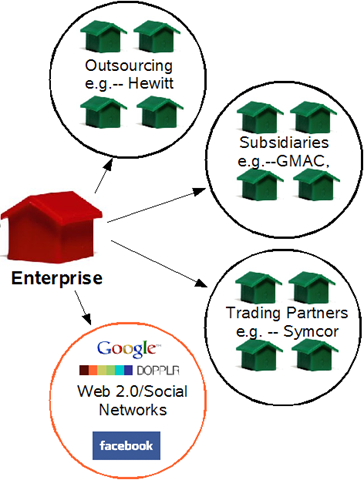
As cloud computing gains momentum as an alternative or complementary means to deploy systems and applications, federation can be a key technology to enable integration between various cloud systems or components.  Discussion of how employ federation in cloud systems has led to interesting statements such as proposed by Symplified, Inc., at the recent Digital ID World Conference: “Federation is Dead. Long Live the Federation Fabric.”

The essence of Symplified’s argument is that using Identity Federation for point-to-point system integration is too complex and expensive.  Therefore a web or fabric of federation is needed to simplify and extend current federation models.  I expect that we will see “Federated Service Bus” technology to emerge to address this need, much like Enterprise Service Bus technology is currently employed to simplify complex integration challenges within enterprise systems.

Recommendations:

To determine how you should address Identity Federation, consider questions such as these:

  • Where have you already employed Federation?
  • Where can federation simplify integration within your enterprise?
  • Where would Federation enable more business value for your customers and your partners?
  • Which of these relationships is highest priority for you?
  • What trust relationships have you already established with other enterprises? 
  • What must you do to establish new trust relationships?
Comments Off on Identity Trend 6: Identity Federation . Permalink . Trackback URL
 

Identity Management Is a Lifestyle

Identity
Author: Mark Dixon
Wednesday, October 7, 2009
6:45 pm

Rolls Royce It is always enjoyable to read advice from those in the trenches of Identity management implementation.  As a recent guest blogger on the Identigral blog,  Tom Ebner outlined and explained ten best practice rules he learned while living the “Identity Management Lifestyle:”

  • Rule #1. Understand the problem and the opportunity
  • Rule #2. Assess the quality of the identity data
  • Rule #3. Create a strategic technical vision
  • Rule #4. Get (and keep) an executive sponsor
  • Rule #5. Build a great team
  • Rule #6. Add great partners to your team
  • Rule #7. Create a strategic technical architecture
  • Rule #8. Deliver something valuable to the business
  • Rule #9. Manage your risk
  • Rule #10. Understand and communicate “What does success look like?”

Thanks, Tom, for excellent advice.  May your continued work in this lifestyle earn you the yacht and Rolls Royce your colleague talked about!

(You’ll have to read Tom’s article to catch the significance of that last statement.)

Comments Off on Identity Management Is a Lifestyle . Permalink . Trackback URL
 

Identity Trend 5: Roles and Attributes

Identity
Author: Mark Dixon
Wednesday, October 7, 2009
5:23 pm

imageThis post is the fifth in a series of eleven posts I am writing about trends in the Identity Management industry.  

The use of roles for identity provisioning and audit compliance has seen growing acceptance in production systems.  Enterprises are getting more value in both operational efficiency and streamlining compliance efforts by leveraging business  roles.  Role management can support compliance efforts even if full automated provisioning is not in place. 

Experience has shown that using a fairly modest number of roles relative to the size of the user population is most effective, rather than engineering and trying to maintain a large number of roles to take care of all circumstances.  A blend of role- and rule-based provisioning appears to strike the right balance.

As roles are implemented, good governance methods are essential to oversee the entire role management life cycle, just as governance over the complete Identity management life cycle in needed.  The governance structure over both life cycles should be closely integrated.

Some companies are finding a broader use of roles than realized at first.  Roles may have been first engineered to drive role-based access control and compliance enforcement, but can also be used for such things are evaluating organization and infrastructure effectiveness.

Attribute-based access control (ABAC) is emerging as a possible alternative to role-based access control (RBAC), particularly for large, complex organizations such as government entities.  This has led some people to predict that ABAC will replace RBAC.  However, if we consider that roles are really a form of attributes attached to Identities, we could predict that the two methods will converge – with the best approach being a balance that leverages roles where appropriate, and attribute-driven rules where that approach makes sense.

Recommendations:

Consider questions such as the following:

  1. Where can roles be leveraged to improve the effectiveness of your Identity provisioning and compliance system?
  2. What is the right balance for your organization in the number of roles and the rules that complement the roles?
  3. How can you effectively govern both the Identity life cycle and role life cycle in your organization?
  4. Are there ways you can leverage the role infrastructure you have adopted in other ways besides RBAC and compliance?
  5. Can emerging methods such as ABAC bring further efficiencies to your operation?

By the way, the stack of hats shown above served to represent different roles or personae a person may possess in a tongue-in-cheek blog post I posted earlier this year: Have a Token: ID Hats and Personae.   I liked Dave Kearn’s perceptive comment to that blog: “Good analogy Mark, but I’m afraid that those of us who understand the phrase ‘to wear different hats’ are getting grayer, plumper and more forgetful every day! People just don’t wear a good homburg, Stetson or Panama any more….”

Comments Off on Identity Trend 5: Roles and Attributes . Permalink . Trackback URL
 

Identity Trend 4: Identity Assurance

Identity
Author: Mark Dixon
Tuesday, October 6, 2009
6:10 pm

imageThis post is the fourth in a series of eleven posts I am writing about important trends in the Identity Management industry.

When you present identity credentials to log into an enterprise system or online Internet site, are you really whom you claim to be?  Do your credentials represent the “real you?”

I published one of my favorite blog posts, entitled “OpenID Credibility: Harry and Bess Truman,” back in June, 2007.  A brief excerpt:

I visited MyOpenID.com and was issued an identifier for Harry Truman: http://harrytruman.openid.com. No validation, no verification of Harry’s real Identity. I just plugged in President Harry Truman’s birthday and home town. I did use my own personal email address, but it wasn’t even validated at the time.

Armed with my new bogus identifier, I marched over to Jyte.com and made a couple of claims: The Buck Stops Here and I Love Bess.

Interestingly enough, the Jyte.com links still work!

This little exercise, where I wasn’t really THE Harry Truman, illustrates the need for Identity Assurance to validate whether my identity credentials really represents who I really am. Identity Assurance can be described as “a means to allow Identity Providers (IdPs), Relying Parties (RPs) and subscribers to determine the degree of certainty that the identity of an entity presenting an electronic identity credential is truly represented by the presented credential.”

With the continual expansion of online fraud and other threats to online security and privacy, the need for Identity Assurance methods are rising.  Being able to certify the that the correct Identity credentials are issue to the correct user before access is attempted is an increasingly critical issue.

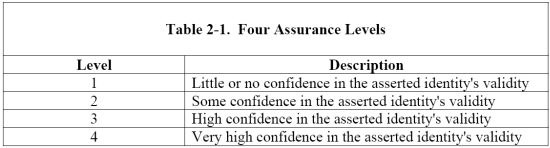
The Liberty Alliance Identity Assurance Framework defines four progressive levels of assurance, depending on confidence in the asserted identity’s validity, as shown in the following table from the Liberty Identity Assurance Framework document.

liberty_assurance01

By comparing the assurance level against the potential impact of authentication errors, we get a clear picture of how the wide spectrum of online access transactions require substantially different levels of Identity assurance.

liberty_assurance02

My impersonating the late Harry Truman requires minimal assurance because the potential impact for the transactions I conducted is minor.  However, at the other end of the spectrum, identity credentials used to conduct high value financial transactions protected by civil or criminal statute are probably worthy of far more stringent Identity Assurance screening.

So, who is responsible to issue high level credentials?  Should it be the government, who is responsible for issuing validated credentials like birth certificates, passports and drivers licenses?  Should it be private enterprise?   It depends on the two factors illustrated above: Assurance Level and Potential Impact.

Recommendations:


Consider these questions for your specific cases:

  1. What level of assurance do you require to match the risk (potential impact) to the cost and complexity of issuing identity credentials?
  2. What different levels may be appropriate for different applications or systems for which you are responsible?
  3. What sources of validation are appropriate to assure that the identity credentials you issue are valid?
  4. What should the role of government or private enterprise have in Identity assurance?

By the way, I still think Harry and Bess look good together.  What do you think?


Identity Trend 3: Authorization

Identity
Author: Mark Dixon
Monday, October 5, 2009
12:37 pm

This post is the third in a series of eleven posts I am writing about trends in the Identity Management industry.

imageOne might say that simple authorization is like permitting entry through the front gate of an amusement park, while fine grained authorization is like granting access to each individual attraction within the amusement park separately, based on some sort of policy.  Following this analogy, the most common method of Identity Management Authorization is like a full-day pass to Disneyland granting access to the front gate as well as every ride in the park.  Similarly, simple Identity Management authorization allows access to all functions within an application.

imageHowever, a trend is growing towards using standards-based, fine grained authorization methods to selectively grant access to individual functions within applications, depending on user roles or responsibilities.  For example, one user could be granted access to only simple data browsing privileges, while another user could be grated data creation or edit privileges, as determined by a policy stored in XACML format.   The definition and enforcement of this fine-grained authorization would be externalized from the application itself.

At the present time, fine grained authorization is desirable but difficult to implement.  It appears to be easier to define and control policies in an Identity system than changing each application to rely on an external system for authorization policy. 

Much is being discussed about policy management standards (e.g. XACML).  Several vendors are effectively demonstrating interoperability based on XACML, but such systems are not yet in broad production.

Recommendations:

As progress is being made in both management of standards-based policies and the enforcement of such policies within applications, the following questions could be considered:

  1. Which of your applications could benefit most from fine-grained authorization?
  2. How would externalizing policy management and enforcement streamline your applications?
  3. How could standards such as XACML improve the management of security and access control policies in you organization?
Comments Off on Identity Trend 3: Authorization . Permalink . Trackback URL
 

Identity Trend 2: Authentication

Identity
Author: Mark Dixon
Friday, October 2, 2009
10:57 am

This post is the second in a series of eleven articles I am writing about trends in the Identity Management industry. 

After all is said and done, Authentication continues to be right at the heart of Identity Management.  Determining whether the correct set of Identity credentials is presented, so a person or process can be granted access to the correct system, application or data, is critical to the integrity of the online experience.   Authentication is like the gatekeeper or enforcer who determines who gets in the door. 

  1. Demand for strong authentication is accelerating as the sophistication and sheer numbers of people who would defraud or damage online systems continue to grow.  More effort is being focused on just how to economically, but securely, implement strong authentication methods to protect confidential information.
  2. As the need for strong authentication grows, there has been considerable conversation about whether the pervasive use of passwords is headed for extinction.  Is the password really on its deathbed? In a Network World column posted earlier this year, Dave Kearns equated passwords to buggy whips.  In my response entitled Passwords and Buggy Whips, I challenged “Replace username/password with what?"  Until we get wide acceptance of alternate methods, it is unlikely that passwords will join buggy whips in the dustbin of history.
  3. In a subsequent post entitled, Seat Belts and Passwords … and Buggy Whips, I proposed that “until ease of use makes passwords irrelevant, people will continue to use buggy whips or drive without seat belts.”  The key issue dogging the industry is how to provide identity credentials that are so easy to use that the technical unsavvy majority can easily use them while providing a level of security commensurate with the rising tide of online threats.

Recommendations:

  1. Assess what level of security is needed for different areas of your enterprise.  In some cases, authentication must protect high value information.  In other cases, less strong authentication may be appropriate.
  2. Seek to understand what your users need.  What methods are both secure and easy to use for them?
  3. Is the cost of strong authentication commensurate with the risk of data loss or compromised system access?
  4. What is the best combination of authentication methods to serve my user community and protect my business interests?

Many years ago, while involved in a large physical security project, we joked that you need to invest enough in your security system so it is cheaper to bribe the guard than to breach the electronic system.  The same principle may be true with Identity Authentication.

Comments Off on Identity Trend 2: Authentication . Permalink . Trackback URL
 

Identity Trend 1: Market Maturity

Identity
Author: Mark Dixon
Thursday, October 1, 2009
2:03 pm

This post is the first in a series of eleven posts I am writing about trends of key importance to the Identity Management industry.

As the following series of photos shows my son Eric progressing from infancy to young adulthood, the Identity Management market has matured, but still has a bright future ahead.

maturity

The Identity Management industry has been building for about a decade.  The market is definitely maturing out of adolescence into young adulthood.  Key characteristics of this maturing market include:

  1. Much focus is being given to best practices of how to maximize enterprises’ investment in these systems.  Rather than focusing on green field Identity implementations, enterprises are concentrating on system refinement, expansion or replacement.
  2. While the industry quite universally agrees that “quick wins” are essential first steps to implementing Identity Management systems, significant additional value can accrue as enterprises expand the reach and scope of their Identity infrastructure.
  3. The importance of Identity governance is becoming entrenched in enterprise culture, as holistic initiatives to address the broad areas of governance, risk and compliance recognize the critical importance of Identity Management in these processes.
  4. Experience has shown that Identity Management is a journey, not a destination.  Enterprises are recognizing that they must approach Identity Management as a long-term program, not a single project.
  5. The industry continues to consolidate, as we at Sun are well aware.  While there are still several emerging niche companies, larger vendors offer complete suites of Identity Management products.
  6. The major business drivers for investing in Identity Management systems still continue to be regulatory compliance, operational efficiency/cost and information security.  However, more focus is being placed on Identity as a key enabler of customer satisfaction through context-aware personalization.
  7. Identity Management is also moving down market, particularly as vendors and systems integrators are addressing the issues of rapid deployment and reduced pricing for smaller businesses.

Recommendations:

In light of this maturing industry, I recommend that enterprises concentrate primarily on the business value Identity Management can deliver.  Questions such as these are appropriate:

  1. Where am I on the journey to implement Identity Management in my enterprise?
  2. Where has Identity Management already delivered value to my business?
  3. Where else can Identity Management deliver value?
  4. How can Identity Management enable Privacy and Security?
  5. How can Identity Management enable compliance?
  6. How can Identity Management increase efficiency and reduce cost?
  7. How can Identity Management enable a better user experience to my customers?
Comments Off on Identity Trend 1: Market Maturity . Permalink . Trackback URL
 

Thanks, Dave!

Identity
Author: Mark Dixon
Monday, September 28, 2009
4:11 pm

I was honored today to have the wise sage of Identity, Dave Kearns, refer to me a “fellow grandfather” and borrow content from my DIDW post (with my permission, of course) in his article about Digital ID World.  It’s always great to share thoughts with Dave.

Comments Off on Thanks, Dave! . Permalink . Trackback URL
 

Identity Management Trends and Predictions

Identity
Author: Mark Dixon
Thursday, September 24, 2009
5:04 pm

crystalball

My Sun Microsystems colleague Dave Edstrom asked me recently to prepare a webinar entitled “Identity Management in 2010: Trends and Predictions” and present it on the weekly “Software Technical Roundtable” he co-hosts for Sun Microsystems employees and partners.  Preparing for this specific event gave me just the right impetus to crystalize my thoughts on this subject, so I thank Dave for giving me the challenge.  I prepared the presentation deck (in OpenOffice, of course) earlier this week and presented the webinar to about 90 people this morning via Webex/teleconference.

I can’t share everything I discussed with our restricted audience this morning, but in this blog post, I’ll briefly describe eleven major trends that I see in the industry.  This is a precursor to more detailed posts I’ll author on each trend over the next several days.

First, a few caveats:

  1. Predictions rarely happen as quickly as we would like.  For example, in 2007 I gave an Identity Trends presentation at the JavaOne conference.  While some of my predictions evolved as expected, several trends have taken longer to develop.  I suppose it will be the same with the trends I describe in this post.
  2. This presentation focuses more on business issues than technology.  I did not attempt to address the trends in specific protocols or products, but chose to focus on the impact of these trends on business.
  3. This list of trends reflects my own opinions, which are not necessarily reflective of Sun Microsystems official positions or product road maps.
  4. This presentation does not represent Oracle in any way.  I have not discussed this list of trends with any Oracle people, nor could I comment on those conversations if I had.

With those caveats, here is my list of the top eleven Identity Management trends for the year ahead.  I really tried to make a nice round list of ten, but I felt it made more sense to separate Authentication and Authorization into separate subjects.

  1. Market Maturity.  The Identity Management market is maturing.  Much focus is being given to best practices of how to maximize enterprises’ investment in these systems.  Rather than focusing on green field Identity implementations,  enterprises are concentrating on system expansion or replacement.  The industry continues to consolidate, as we at Sun are well aware.
  2. Authentication. Demand for strong authentication is growing as enterprises and government agencies seek to deter cybercrime. While some have predicted “death of the password”, the widespread use of UserID/Password as the predominate method for authentication will most likely not go away until we see wide adoption of alternate authentication methods that are both secure and easy to use.
  3. Authorization.  Fine grained authorization is increasingly desirable but difficult to implement.  Policy management standards (e.g. XACML) are also desirable, but not in broad production.  Complexity in adapting applications to take advantage of standard authorization methods will continue to delay adoption.
  4. Identity Assurance.  Answering the question “are you really whom you claim to be?” prior the issuance of Identity credentials continues to be a thorny problem, but is increasingly important in the ongoing battle against fraud. The Liberty Alliance Identity Assurance Framework provides a valuable industry model that defines four levels of assurance, based on confidence in the validity asserted identities and the potential impact of errors.
  5. Roles and Attributes.  There is a growing acceptance of role based access control in production systems.  Governance of the role definition and maintenance process, linked to governance of the Identity Provisioning governance process, is essential.  Enterprises are discovering that the use of roles is potentially broader than RBAC, including use of data analytics to evaluate the effectiveness of organizations.  The use of attribute-based authentication is being hailed in some markets, particularly the public sector, as an alternative to RBAC.  However, a blended approach may be the best solution.
  6. Identity Federation.  In some ways, Identity Federation is a given.  SAML is broadly used a standard protocol and successful business models have been implemented.  However, broader adoption is often difficult because business challenges are larger than technology challenges.  Burning questions swirl around the challenges of using federation in cloud computing.
  7. Regulation.  Government regulations (e.g. SOX, HIPAA/HITECH), which primarily address governance, security and privacy issues, will continue to expand, both on national and state/province levels.  For example, the HITECH Act which became law earlier this year expanded HIPAA security and privacy regulations to address business partners, and added security breach notification to the national statute.  At the same time, industry-driven regulations such as PCI DSS also impose stringent requirements on online merchants.  In all these areas, Identity is a critical enabler for compliance.
  8. Personalization and Context.  Personalization can enhance the value of online user experience.  Both identity and context are essential for personalization.  Concepts such as “persona selection” and the “purpose-driven web” focus on enriching user experience by blending identity and context.
  9. Identity Analytics.  Advanced data analytics will bring value to many identity-based activities such as Authentication (historical “fingerprints” based on your patterns of accessing online resources), Context/Purpose (predicting preferences from your historical activity) and Auditing (who really did what when?).
  10. Internet Identity.  Identity systems for the Internet must efficiently accommodate billions of individual Identities.  User-centric or user-managed Identity technologies such as Infocard/Cardspace and OpenID are trying to address the inherent tension between security and ease-of-use requirements.  Commercial Identity providers are emerging, including the likes of Facebook, Google, Yahoo, PayPal, Equifax and others, both in public and private sectors.
  11. Identity in the Cloud.  Identity as a Service (IDaaS) is a critical foundation for Cloud Computing.  A number of IDaaS companies are emerging to address this specific need.  One of the main barriers to effectively implementing Identity in the cloud is the increased complexity of having to establish effective trust relationships between enterprises and service providers, while protecting the security and privacy requirements imposed by customers and regulations.

So, there is my list of eleven major trends.  Your list or focus on specific topics might different.   Please let me know what you think.  Please also stay tuned to my discussion of these eleven trends in future blog posts.

Comments Off on Identity Management Trends and Predictions . Permalink . Trackback URL
 
Copyright © 2005-2016, Mark G. Dixon. All Rights Reserved.
Powered by WordPress.