What in the world is the Fedlet?

 What is the Fedlet? Frankly, I don’t know. My colleague Daniel Raskin promises to let us know soon.
Technorati Tags: Identity,
Digital Identity,
Identity Management,
Federation

What is the Fedlet? Frankly, I don’t know. My colleague Daniel Raskin promises to let us know soon.
Technorati Tags: Identity,
Digital Identity,
Identity Management,
Federation
 Personal Device: ” … intended to convey a sense of the aspirations or character of the bearer.”
In a conversation with a telco executive recently, he remarked that their company had stopped referring to “smart phones,” but rather favored the term “personal devices.”
His comments triggered some fun memories. I thought of the time way back in 1978 when I sat down with a colleague and sketched out a concept for a hand held electronic notebook and calendar device. Surely, we thought, we could add calendar and note taking functions to electronic calculators to make something really useful. We each signed the pages of our engineering notebook and vowed we would become millionaires and change the world. But we were just naive, inexperienced junior engineers who had no idea about how to bring such a thing to market. Our little idea made it no further than the pages of our notebook and the shadows of our dreams.
Fast forward to the Internet boom in the late 1990’s. I was shuttling around the world every week with my colleagues at Oracle, carrying three personal devices – a cell phone, a pager and a Palm Pilot. I would frequently remark that these three indespensible gadgets should be combined into a single device.
Three years ago, when I bought my first Treo, Progressive Convergence became reality for me. My personal device that took the place of three became an indespensible part of my Identity – a literal extension of my persona.
But now? I’m back to carrying three personal devices – my Treo, my iPod and my Magellan GPS navigator (split personality, you ask?). I have still not found the best functions of each device in a single unit. However, the phenomena of Progressive Convergence will undoubtedly quickly bring the best merits of all these functions together in a single device.
So, what do I really want in a personal device? I’m not sure I really know, because someone will undoubtedly offer up something I hadn’t thought of. But here are some ideas:
The crazy thing about this? I am sure that I have grossly underestimated what my personal device will be like in 10 or 20 years. I’m still amazed when I think about what the last 20 years has provided. I can’t wait!
Technorati Tags: Identity,
Digital Identity,
Identity Management,
Personal Device,
Convergence
 Convenience: “anything that saves or simplifies work or adds to one’s ease or comfort.”
In a meeting at Sun’s Executive Briefing Center last Friday, one of our telco customers volunteered the mantra driving their implementation of Identity Management to enable delivery of online services. “It’s all about convenience for our customers,” remarked one executive.
Convenience implies making life easier, simpler or more comfortable. Identity Management principles and technology can indeed simplify the process a subscriber uses to interact with an online service provider. While the visible process is simplified, people can also be more comfortable they are interacting in a safe way, with privacy and security concerns appropriately addressed.
An interesting thing about Identity Management is that if it really works, it is almost completely hidden. The building blocks that operate behind the scenes just go about their work without users even being aware of the complex protocols and processes required. But it is that very real, but unseen “magic” that really delivers value to a company whose mission is “Convenience for our Customers.”
Technorati Tags: Identity,
Digital Identity,
Identity Management,
Telecommunications
 Well, the cat is out of the bag. I can now blog about the major initiative that has been monopolizing my time for the past six months.
This morning, Slashdot picked up the post by BobB-nw: “Telecommunication companies need to go beyond just providing bandwidth and look into acquiring Internet destination sites that are heavily trafficked, says Sun Microsystems Chairman Scott McNealy. “I have explained to every telco that either you become a destination site, or the destination site will become a telco,” McNealy said at a news conference at Sun Microsystems’ Worldwide Education and Research Conference in San Francisco on Wednesday.”
I am the guy in Sun’s Americas Software Practice tabbed with leading the effort to make Scott’s vision a reality for our large telecom customers. If you were here with me at Sun’s Immersion Week today, you could attend my class for Sun systems engineers on the topic of Project Destination.
Project Destination is a Sun Microsystems initiative to give reality to Scott’s vision that: Telcos must become “Destination Brands” or they will be only “Network Gateways” to companies that are Destination Brands (note that I said “Brand”, not “Site.” The term “site” is too limiting. We are talking about services delivered across the spectrum of online devices – phones, TVs and web browsers.)
A Destination Brand will:
What in the world does this have to do with Identity? Identity is at the very heart of delivering highly personalized, context aware services to subscribers on their choice of device. I like to call it “Identity-enabled Service Orchestration.” Stay tuned over the next few weeks as I discuss issues and solutions in more detail.
Technorati Tags: Identity,
Digital Identity,
Identity Management,
Sun Microsystems,
Destination,
Telecommunications
 One of the significant benefits of getting together at training events like Sun Immersion Week is participating in ad hoc whiteboard discussions like the one where I caught my colleague Tom Limanek in an intense Identity Management discussion. In an era of extensive conference calls and virtual interaction, it is sometimes very refreshing to have some serious face time together.
Technorati Tags: Identity,
Digital Identity,
Identity Management,
Sun Microsystems
 It was good to see Scott Fehrman’s report on the first Sun Identity Manager User Group meeting in the Chicago area, held Tuesday, February 19th. User group meetings such as this are great forums for our customers to provide feedback to Sun and for sharing experiences and best practices that enhance all participants’ abilities to leverage their investment in Identity Management technology and processes.
The next User Group meeting in the Chicago area will be help at the Sun Itasca Office @ 6:30 pm on Thursday May 22nd 2008. The following items will be addressed in that meeting:
If you’re interested in joining the user group, please send an email to “Chicago_IdM_LUG [at] Sun [dot] com”.
Technorati Tags: Identity,
Digital Identity,
Identity Management,
Sun Microsystems
 On February 15th, Sun completed its acquisition of Vaau, a premier provider of Enterprise Role Management (ERM) and identity compliance solutions. Please allow me to add my welcome to these great folks and great technology. I was pleased with Sun’s announcement last November to acquire Vaau. It is always great to see good business transactions like this come to fruition.
Last week, I joined Sun software specialists from all over the world at a three day training event focused the RBACx product (now Sun Java System Role Manager) and related methodologies. We got to install to software, kick its tires, discuss the intriguing processes of applying the Vaau technology to business problems and hang out with a few of the key people in the organization.
In our training class, the characteristics that resonated most with me were:
I still have much to learn, but am confident this acquisition and the ongoing work to integrate the technology and people into Sun will be positive for our customers and for Sun.
Technorati Tags: Identity,
Digital Identity,
Identity Management,
Sun Microsystems,
Vaau
My son Ryan, a freshman at Arizona State University, pointed me to this video. The global perspective it shares is certainly worth the few minutes it takes to watch.
We who focus professionally on Digital Identity sometimes forget that many of the world’s people have nothing digital to access or protect. For too many, the most important part of personal identity is all wrapped up in how to survive the day.
Technorati Tags: Identity,
Digital Identity,
Identity Management
 As my colleague Pat Patterson reported earlier today, we are holed up in a windowless conference room in the Tropicana Hotel in Las Vegas for the FAMFest 2008 event. There is immense brain power in this room!
During a few minutes of downtime, Pat showed me the good work done by SSOCircle in leveraging OpenSSO to establish federated linkages to a wide variety of service providers. To test the system, I established an SSOCircle account and linked directly to the suite of Google apps as “mgd@ssocircle.com.” OpenSSO handled all the heavy lifting behind the scenes.
I verified that I could send and receive email as “mgd@ssocircle.com” via Google email and link my ssocircle.com calendar to my personal Google calendar. Great little demonstration of the power of federation to provide SSO to multiple SaaS applications.
Technorati Tags: Identity,
Digital Identity,
Identity Management,
Sun Microsystems,
SSOCircle,
Google,
Federation
On December 18th, The Liberty Alliance Announced the First Companies to Pass Full-Matrix SAML 2.0 Interoperability Testing. I was delighted today to see the report card that showed Sun passing every functional test. Congratulations to the Sun Federation and Access Manager team for a job well done!
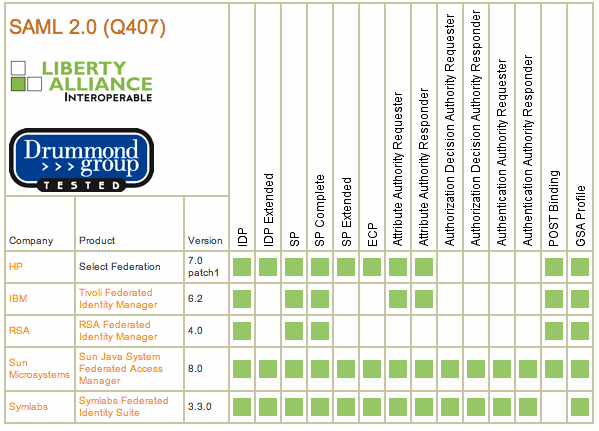
You can click on the image or here to see a full-size table.
Technorati Tags: Identity,
Digital Identity,
Identity Management,
SAML,
Liberty Alliance,
Sun Microsystems